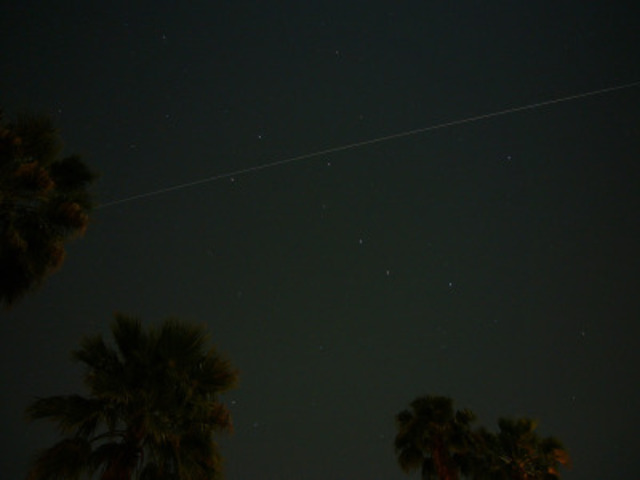
 Photo by °Florian of an ISS pass in California, used under Creative Commons license.
Living so close to major airports, military bases, and, of course, the White House, watching aircraft fly over D.C. is not exactly an unusual phenomenon. Have you ever looked up and seen something moving far too fast for a 757, but far too bright for an F-15? Well, you weren’t having an X-Files moment, so much as catching a glimpse of the International Space Station. Its orbit occasionally brings it right overhead; in fact, it’s been passing over the mid-Atlantic all week in the 6 p.m. hour. The ISS, on which the United States started construction in low-Earth orbit in 1998, gets bigger and bigger (and thus, brighter and brighter) every year. With construction nearly finished, it’s become so bright in the sky that some people are claiming they can even see it during the day.
There are a couple ways to find out where and when to look up for the ISS. NASA has an Applet (which looks like it was pulled right out of your old Apple II), where you can enter your zip code and click “Next Sighting.” Click on the “SkyLog” tab for a slightly easier directional reading, which tells us we should have an ISS sighting tonight at “18:05, Pass 03m00s, Max Elevation 21, Approach 15 Above WNW, Departure 14 Above NNE.” That means tonight’s pass will start at 6:05 p.m., in the West to Northwest sky, rising slightly to just 21 degrees above the horizon as it crosses over to the North/Northeast sky, setting out of sight only three minutes after it appears. Unfortunately, 15-20 degrees is usually too low for us city folks to see over our buildings and tree lines, so it may not come into view for most of us tonight. NASA’s application will let you look up all future passes, but to make it real easy, start following @twisst on Twitter. If you have your location (i.e. Washington, D.C.) in your profile, it sends you an @ reply whenever there is an ISS sighting in your area.
Planets: It became almost comforting to look up for most of 2009 and see Jupiter shining so brightly in the night sky. The Jovian planet sets earlier and earlier now, sinking in the southwest sky around 8 p.m. Instead, look up for a glimpse of the red planet, Mars — not quite as bright as Jupiter, but still easy to find in the sky — rising in the east-northeast around 7 p.m. Saturn is visible for the night owls, rising in the east around 11 p.m. — or if you’re an early riser, see it high in the south just before dawn.