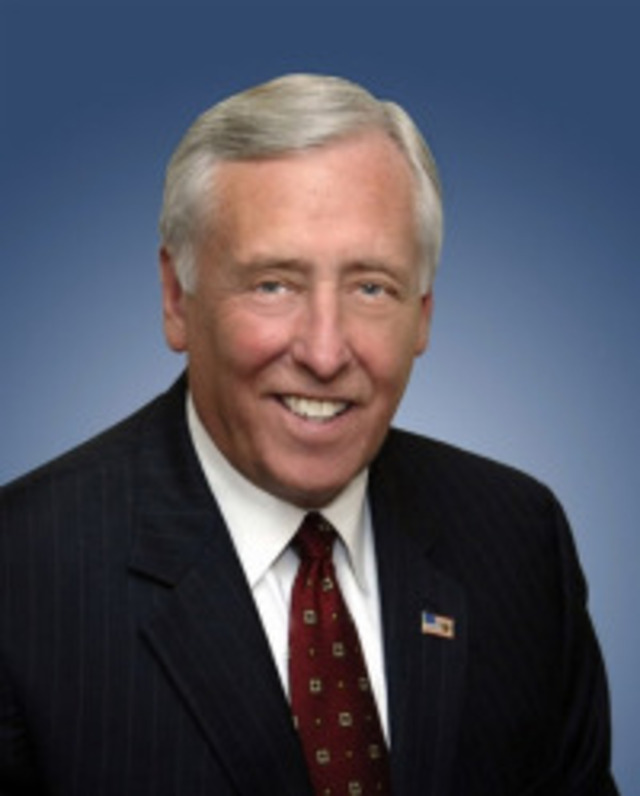
 Steny Hoyer (D-Md.)
House Majority Leader Steny Hoyer (D-Md.) told reporters Tuesday that the reason the D.C. House Voting Rights Act has not been brought to the floor for a vote is because local D.C. political leaders have yet to come to a consensus on a controversial handgun amendment that remains attached to the Senate version of the bill.
The most recent version of the voting rights bill passed the Senate almost a year ago, but got held up in the House by the Senate amendment, which would have done away with the District’s gun laws.
Hoyer made his remarks at his weekly pen-and-pad press conference in his office, after taking questions from WTOP political analyst Mark Plotkin. A DCist operative was there and sent in the following account.
Plotkin asked Hoyer whether the handgun amendment added to the Senate version of the bill could be described as a kind of “castor oil” that could help the bill move forward despite being distasteful to Democrats and local politicians.
“The castor oil, obviously is pretty tough stuff for a lot of people. My opinion: an inappropriate addition to this legislation,” Hoyer said. “We can act individually on that if Congress wants to do that. But having said that, as you know, one possibility was to move it and to take care of that issue later. There were some people in the District of Columbia who thought that was a way forward. My posture has essentially been: If we can reach consensus in the District of Columbia, I’m going to move that bill if I think it can get the votes on the floor with the consensus that has been reached. I have not seen that at this point in time.”
“I want to get this done,” Hoyer continued. “It’s one of the biggest frustrations for me personally during the course of this Congress — and frankly in previous Congresses.”
Plotkin then asked if it would make a difference for President Obama to mention D.C. voting rights in tomorrow’s State of the Union address, as organizations like DC Vote have strongly advocated:
“I don’t think there’s any doubt that the president is for D.C. voting rights,” Hoyer said. “He’s said it numerous times, he voted that way in the Senate, and I’ve had discussions with him. He’s for it. He, like me, is trying to figure out what the leadership in the District of Columbia wants to do and if they’re united on their purpose … I don’t mean 100 percent united. I don’t want you to take ‘united’ as 100 percent. However, as a political leader, I like consensus. Consensus doesn’t mean that everybody says, ‘Amen.’ It does mean that most say ‘Amen’ and others are saying, ‘Well, if this is the view, I’ll be there.’ And I think that’s where the president is.”
Last year, Mayor Adrian Fenty publicly sided with passing the legislation, the gun amendment notwithstanding, while other elected officials argued that any such amendment would be an affront to Home Rule. President Obama remained quiet on the issue throughout 2009, disappointing activists who assumed he would more actively side with granting District residents full voting rights.
Martin Austermuhle contributed to this story