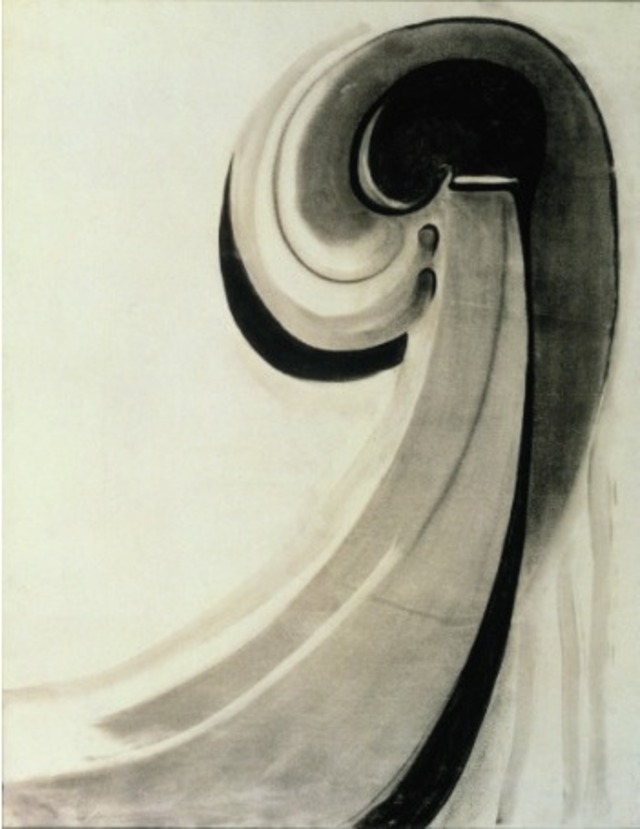
 Early Abstraction, 1915, Charcoal on paper, 24 x 18 5/8 in., Milwaukee Art Museum, Gift of Jane Bradley Pettit Foundation and The Georgia O’Keeffe Foundation, M1997.189, (CR 50), Photography by Malcolm Varon, © Milwaukee Art Museum
As one of the few American women painters of the 20th century to receive notoriety, Georgia O’Keeffe’s body of work is characterized as modern, abstract, representational, feminist and highly sexual. Interpretation of her abstract flowers, skeletal bones and landscapes have been debated throughout her life with O’Keeffe largely rejecting the later characteristics and interpretations she didn’t like.
Georgia O’Keeffe: Abstraction at The Phillips Collection contains all of the expected paintings of flowers and landscapes, with emphasis on her earlier abstractions, and also offers a glimpse into the personal life of the artist. Classics such as her Music, Pink and Blue series and Jack in the Pulpit works are exemplary of the style O’Keeffe became known for and embattled in feminine analysis. The familiar fluid lines and often soft color palette adorn the walls. They are familiar markers of her life’s work.
It’s inevitable that with any showing of her work, along with Freudian judgment, mention has to be made of Alfred Stieglitz and their relationship. This exhibit is no different, offering 14 photographic portraits of O’Keeffe by Stieglitz. The addition of these photographs gives a better grasp of O’Keeffe as a persona and artist; perhaps only through the eyes of Stieglitz and his sexual readings of her work. But the most compelling additions here, that claim otherwise, are a selection of letters to and from O’Keeffe and Stieglitz.
In one, O’Keeffe asks Stieglitz what he thought of her drawings. “…I make them – just to express myself – things I feel and want to say – haven’t words for…” Stieglitz responds, “It is impossible for me to put into words what I saw and felt in your drawings…”
Stieglitz sentiment is apt, as the exhibit opens with these powerful charcoal drawings from early in her career. They show the same spiral and curve abstractions as her paintings and produce the same visual impact, but they are strong in black and white, yet as fragile as the paper they were created on.
Early Abstraction whisks your attention up and into the depths of a black circle. For a fairly messy medium, O’Keeffe’s lines here are controlled but still maintain an energetic feel and while this early work might not look typical of the artist’s style, the organic lines and spiral shape are seen throughout her career. An argument can be made that the dark depth of this piece is the beginning of her feminist work and open to such interpretation, but it is in strong visual contrast to her later paintings that are more easily left to that judgment.