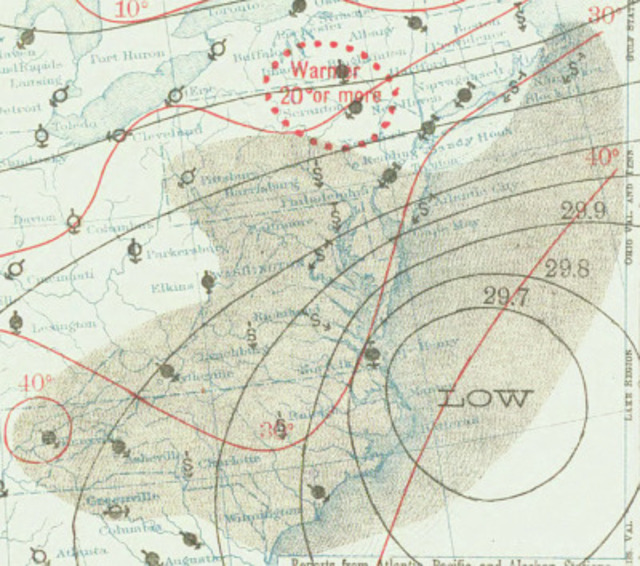
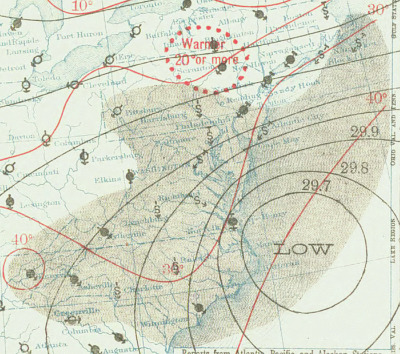
 Weather map of the 1922 blizzard.
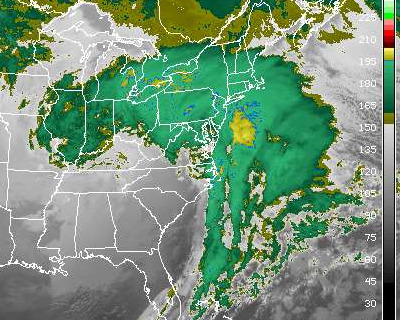 Infrared image of the 2010 blizzard.
While battling cabin fever and trying to find that tray you stole from your college cafeteria for sledding, you might be wondering where the current snomgasm, snowmageddon, or whatever ranks in the all-time pantheon of D.C. area weather storms. The National Weather Service sure likes the chances of record-breaking accumulation; as far as we can tell, there’s a pair of historic storms which compare well with the one that’s currently sauntering its way through our city.
The most frequent comparison is obviously the infamous Knickerbocker Storm of 1922. That storm — named for the roof collapse of the Knickerbocker Theatre which killed 98 and injured 133 — churned out at least 20 inches of powder across a 22,400 square mile radius in the mid-Atlantic and northeastern United States beginning on January 27, 1922. That storm produced an incredible amount of snow — reportedly measuring a record 33 inches in Rock Creek Park — in a very short period of time and mostly overnight, much like the current one. But there are differences — temperatures between January 24 and 28 in 1922 didn’t once reach above freezing, while we’ve experienced some temperatures in the 40s over the past few days.
Our own Amanda Mattos took a look back at the Knickerbocker Storm on the 87th anniversary of the roof collapse in 2009 — while we may match the same levels of snowfall, one can only hope the carnage caused in 1922 is never replicated.
But this storm also is reminiscent of the Blizzard of ’96, when the District — along with seemingly every city on the Eastern seaboard — was hammered. 1996’s storm was punctuated by frigid blasts of wind along with anywhere from 18 to 24 inches of the white stuff, which sounds a lot like what’s going on outside our window. The Presidents’ Day snowstorm of 2003 also shares some similarities, though final figures from this weekend have already eclipsed the 12-18 inches we got nearly seven years ago.
In any case: no matter how much 2010’s blizzard eventually drops on D.C., you can always glance at Washington’s average snowfall figure for February and have a hearty laugh.