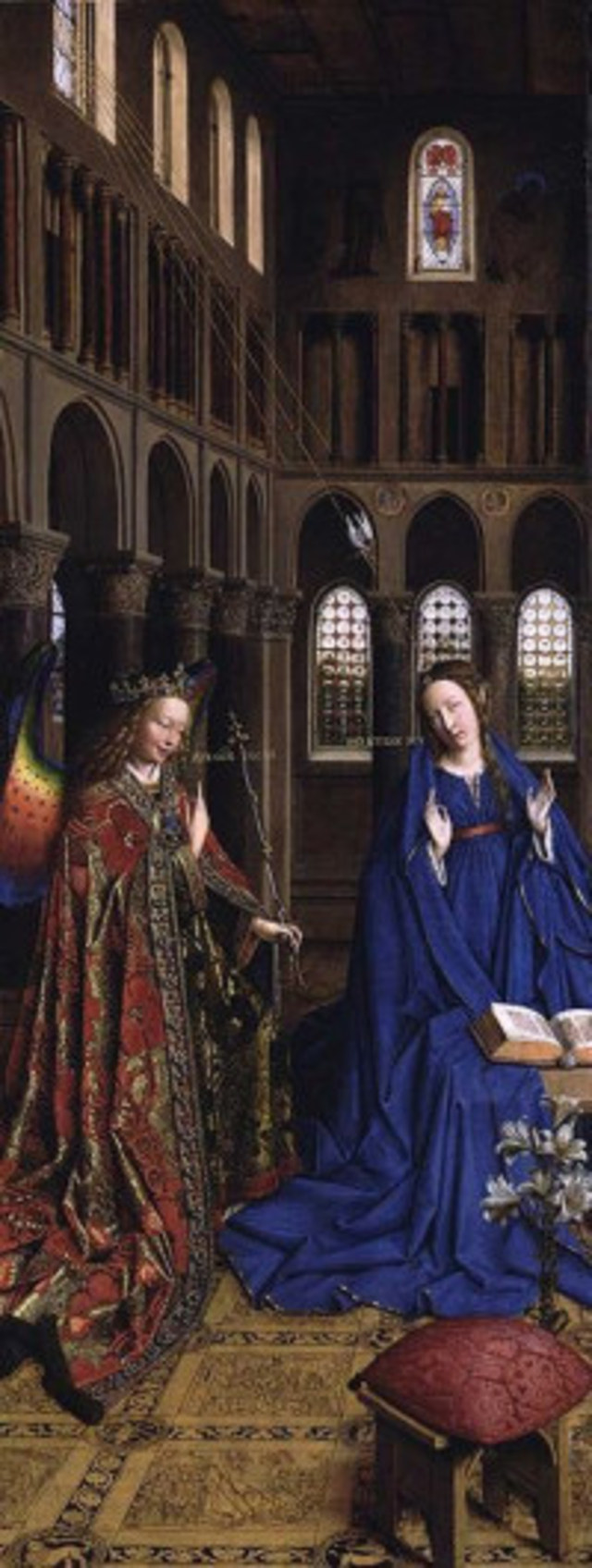
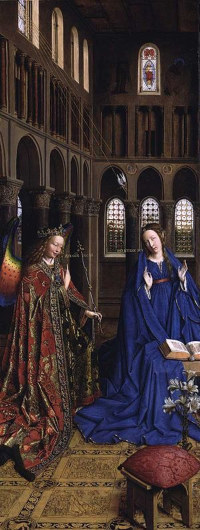
 Image of Jan van Eyck’s Annunciation, courtesy the National Gallery of Art.
Written by Aleid Ford, who is profiling 365 masterworks at the National Gallery of Art this year for her project Art 2010, which appears on her website Head for Art.
The Netherlandish painter Jan van Eyck (c. 1390 – 1441) was one of the best and most important artists of the Northern Renaissance, and his Annunciation at the National Gallery of Art leaves no question in the mind as to why. It shows the moment of the annunciation (from the Latin annuntiare, to announce) as described in the Bible in the Gospel of Luke: the angel Gabriel delivers a message to Mary, that she’ll conceive a son, the Son of God.
Today is the Feast of the Annunciation, commemorating Christ’s miraculous incarnation nine months before the Nativity at Christmas. The annunciation was a central topic in Christian art during the Middle Ages and the Renaissance, physicalizing this most ungraspable of events. Van Eyck’s version (1434 – 36) was probably once the left wing of a triptych (a three-paneled piece). The picture spells out in golden script the words spoken at the meeting: Gabriel’s greeting (“Hail Mary, full of grace, the Lord is with you”) provokes Mary’s response of humble faith (“I am the handmaid of the Lord; let it be done to me according to your word”).
But it’s more than words that are written here: van Eyck’s skills are clearly legible on the canvas. He was an artist of rigorous observation, a “what you see is what you paint” kind of guy. He was especially sensitive to the fall of light, so that his physical forms (even that of the archangel) become laden with weight and invested with volume. See the shading that renders the faces round and the way he describes folds of cloth, delineating precisely where Mary’s mantle and Gabriel’s cape turn away from the light.
The facial features are also remarkable. Van Eyck was a gifted portraitist, with a nit-picking eye that he brings to bear here. I adore Gabriel’s rounded, apple-red cheeks and the way Mary’s tucked-in (dimpled?) chin ripples her neck. The fact these faces are 3/4 view (rather than profile) gives us a chance to read the expressions. This lends human freshness to a scene like this, since we can relate to Gabriel’s joy burst and Mary’s consternation.