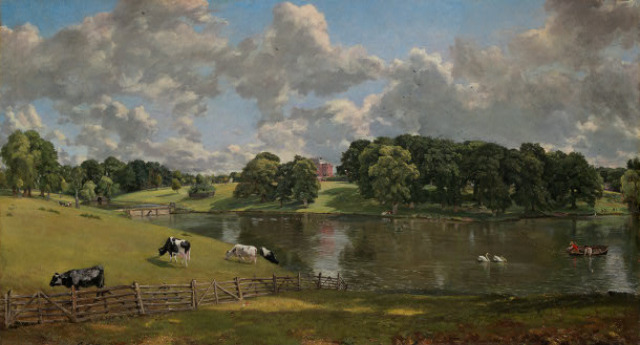
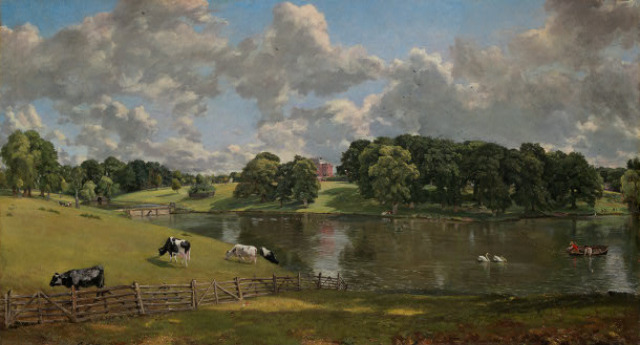
 Image of John Constable’s “Wivenhoe Park, Essex” courtesy of National Gallery of Art
Written by Aleid Ford, who is profiling 365 masterworks at the National Gallery of Art this year for her project Art 2010, which appears on her website Head for Art.
“No two days are alike, nor even two hours; neither was there ever two leaves of tree alike since the creation of the world.” So said John Constable (1776 – 1837), regarded by many as England’s greatest landscape painter. His work Wivenhoe Park, Essex (1816) at the National Gallery of Art vibrates with the verdant essence of the countryside. Constable’s studies, sketchbooks and paintings all reveal the profound connection he felt to the landscapes of his native Suffolk and the surrounding counties.
Wivenhoe Park, Essex was commissioned by the owner of the estate, Major General Francis Slater-Rebow, who’d been a friend of Constable’s father and was the artist’s first important patron. The work, done in oil on canvas, conveys how Constable was keen to capture particular sensations created by nature. He used brushwork to this end: look to the vigorous strokes on the water, that whip the paint into a reflecting pool. Elsewhere, the precision of the brush clarifies small details, such as the cows and people, for example. The colors also add to the immediacy: white dashes on the clouds flash sunlight through the sky, and the dappled dark-to-light green ground brings in the breath of a breeze.