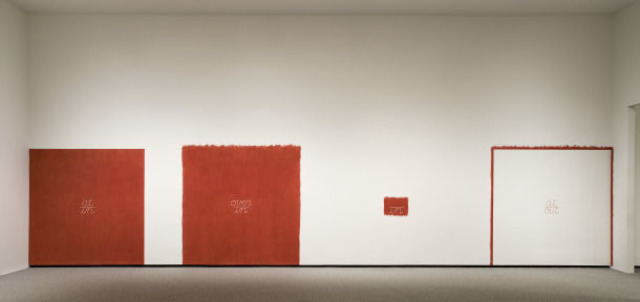
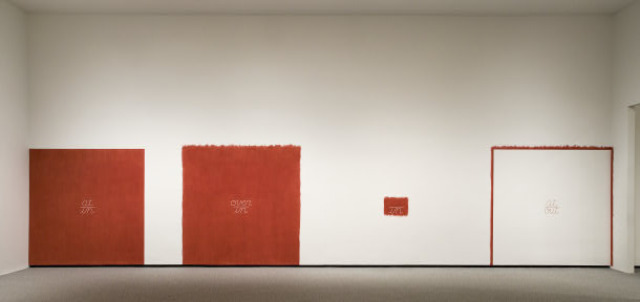
 Image of Mel Bochner’s Theory of Boundaries, courtesy the National Gallery of Art
Written by Aleid Ford, who is profiling 365 masterworks at the National Gallery of Art this year for her project Art 2010, which appears on her website Head for Art.
Over three days in February 2007, artist Mel Bochner and his assistant installed Theory of Boundaries (1969 – 1970) at the National Gallery of Art in the East Building. The work consists of four squares of equal size, each separated by a space equal to one-third of the width of a single square. Dry pigment is applied directly to the wall, with each square following the principles determined by a “language fraction.” So “at/in” describes the hard-edged square at the left, while “over/in” refers to the blur-edged one next along, and so on. In wordage and image, each square represents a different relationship between colored surface, border, and state of enclosure.
Mel Bochner (American, b. 1940) moved to New York in 1964 and got involved in two of the major movements of the time: Minimal art (already being developed by artists like Donald Judd, Dan Flavin, and Sol LeWitt), and Conceptual art, a then-nascent movement of which Bochner would become a key figure. The two strains of influence are evident in Theory of Boundaries: on the one hand, it’s object-based in its revealing the “mechanism” of its creation, and on the other it’s art that proposes an idea, rather than a physical object.