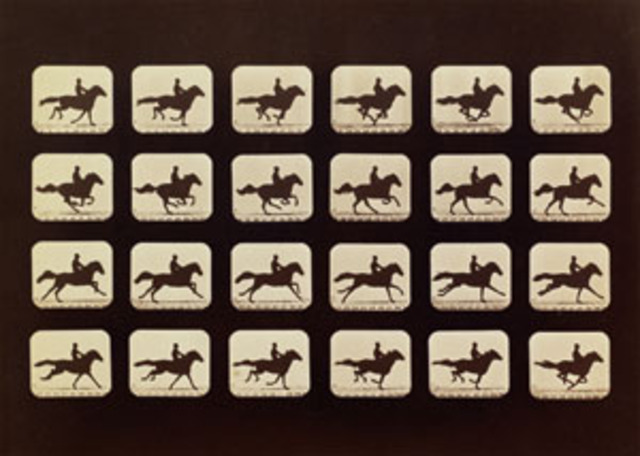
 Eadweard Muybridge, Horses. Running. Phryne L. Plate 40, 1879, from The Attitudes of Animals in Motion, 1881. Albumen silver print. Image courtesy of the Board of Trustees, National Gallery of Art, Washington, Gift of Mary and Dan Solomon 2006.131.7.
In the fast moving era of the industrial revolution, Eadweard Muybridge was and still is considered a pioneer and innovator. He helped redefine how we view the world with his studies of human and animal locomotion. He stopped time, then reanimated it, exploring early cinematics. In Helios: Eadweard Muybridge in a Time of Change, the Corcoran brings together a retrospective of over 300 selections from Muybridge’s body of work from 1857 to 1893.
Muybridge started out as a photographer in the late 1860s in San Fransisco. Even early in his career he was considered ingenious with a camera, often shooting unconventional angles and compositions. He did this especially when documenting the expansion of the railroad. He would place his camera above the tracks or down onto the rails for unexpected views. Long Ravine Trestle and Bridge—113 feet high, 878 feet long, looking East (766) is one such example. The composition highlights the side of the bridge, showing off its intricate pattern made from the criss-crossing of the wooden beams.
The photograph of the trestle bridge as well as many others within Muybridge’s portfolio are a large selection of stereographs from this time period. The stereograph consists of two shots printed side by side and viewed with special glasses. The two images merge into one and become slightly 3D. These are characteristically small prints and seem unusual in comparison to today’s almost unlimited scale. While small, the photographs and compositions are not diminished by the parlor entertainment of the stereograph. Muybridge’s knack for exploring detail and uncovering emotion is present within these miniature landscapes and portraits.