Martin Austermuhle
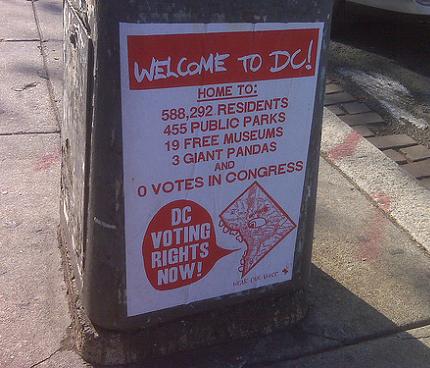 Photo by HeatherMG
After this week’s aborted attempt to bring the D.C. voting rights bill to a House vote, District residents are likely looking at another long hibernation before any proposals to end the city’s disenfranchisement can come before Congress. The trade-off that was the legislation’s main selling point — a seat for D.C. and a seat for Utah — becomes moot later this year, not to mention the persistent threat of a gun law-gutting amendment that will likely sink any future attempts to put the bill to a vote.
So what’s next? To be truthful, probably no one knows. Over the last three years, the District’s main elected officials and advocacy organizations have pushed for the legislation, but with its death all but certain after this week’s developments, there’s uncertainty surrounding what’s left on the horizon. (Interestingly, though, DC Appleseed Center director Walter Smith said in a statement today that they would keep pushing for the bill to pass, either by attaching it to another measure or as free-standing legislation.)
Post Metro columnist Robert McCartney highlighted yesterday how desperate the voting rights movement is for new energy and new ideas when in a column he proposed a creative, if preposterous new tack to gaining voting representation — “First, give the District two Senate seats, as well as the House seat. Second, give California two extra Senate seats. This could be done by splitting it into two states or amending the Constitution.”
Late last year I somewhat idealistically mused that maybe statehood will again become the rallying cry, but it would take years of work to build up a constituency broad enough to move such a proposal forward. Vince Gray said much the same thing on Thursday.
Novel fantasies aside, there remains the question of Del. Eleanor Holmes Norton. Though it was ultimately her decision to pull the bill, she also gave it her blessing, gun amendment and all — albeit a hesitant one — last week. That Norton had briefly surrendered on the gun amendment served to stir up what had been festering but mostly quiet divisions within the voting rights movement to become very public, as members of the D.C. Council and various organizations refused to sign on to the compromise. And as the City Paper’s Loose Lips noted, her announcement came at the worst possible time for most local officials — in the midst of an election year and mere weeks after the South Capitol Street shooting that left four dead and five others injured.
No one doubts Norton’s dedication to voting rights, but mutterings over whether or not someone else could bring new energy to the position — next year it will be 20 years since she was first elected — could well get louder.