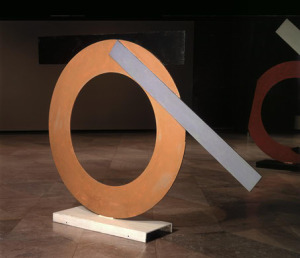
 David Smith’s “Circle I”.
Written by Aleid Ford, who is profiling 365 masterworks at the National Gallery of Art this year for her project Art 2010, which appears on her website, Head for Art.
Circles crop up all the time in art, as catch-all symbols for things like union, wholeness and cyclicality. It was the circle that the sculptor David Smith (1906-1965) selected as the sole compositional focus for his works of the early 60s. His Circles I, II and III at the NGA are related: all dated 1962, they’re made of painted steel and each weigh 500 pounds. And yet, they stand alone too, differentiated by color, interior diameter size and by those geometric shapes welded to their sides.
Smith is seen as America’s greatest modern sculptor. The son of an engineer, he started out as a welder and riveter at an automobile plant in Indiana. He went to New York to train as a painter in the mid 1920s, but turned to sculpture in the 1930s after seeing Picasso’s and Julio Gonzalez’s metal structural pieces. In 1934 he set up a studio at Terminal Iron Works, a machinist shop in Brooklyn, where he started fusing the materials and methods of mechanical trade into his art.
It is undoubtedly Smith’s brash and breezy approach to material (machine parts, scrap metal, found objects) that sets him apart as an artist. In the case of the Circles, you’re never far from the facets of the steel he has shaped and shaved. I think the material bore crucial connotations for this man, who worked during World War II as a welder of tanks and locomotives in a defense plant. Smith said in 1952, “What associations it (steel) possesses are those of this century: power, structure, movement, progress, suspension, destruction, brutality.” Smith’s subtle brilliance shines in the marrying of his modern, American, industrial materials with a gentle, painterly touch. So in the case of the Circles, their polychromed surfaces are visibly tickled by the traces of the artist’s brush.