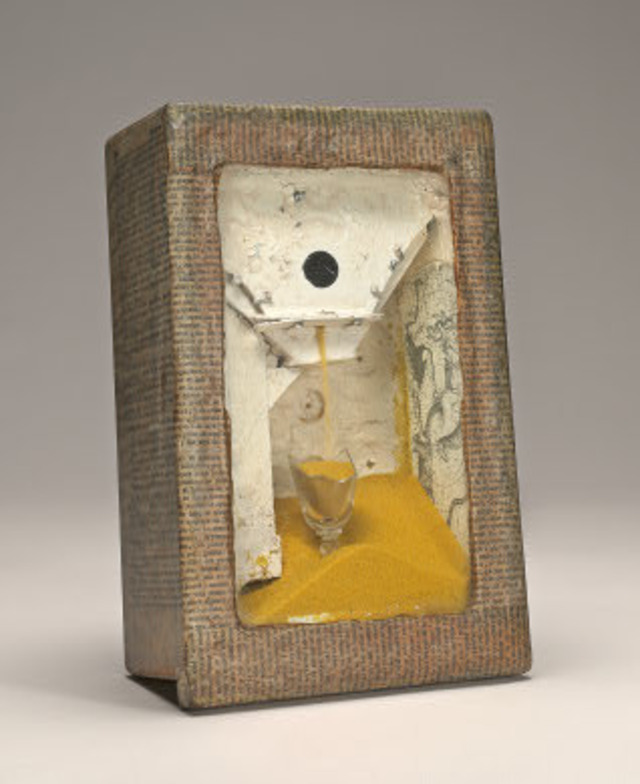
 Image of Joseph Cornell’s “Sand Fountain,” courtesy the National Gallery of Art
Written by Aleid Ford, who is profiling 365 masterworks at the National Gallery of Art this year for her project Art 2010, which appears on her website Head for Art.
I recently came across a video of Kseniya Simonova, a Ukrainian sand artist. Beguiling to see, she scatters and shapes sand across a light box, as if painting with the particles. See here for the performance that won her Ukraine’s take on America’s Got Talent, in which she uses sand to interpret Germany’s occupation of her country during World War II. Be prepared though, to feel shocked, somber and staggered after seeing it.
Simonova’s sand work pointed me in the direction of Sand Fountain (1948) by Joseph Cornell at the National Gallery of Art. An American, Cornell (1903 – 1972) is best-known now for pioneering Assemblage art, which uses 3D found objects to create works. Assemblage art was only properly established in the 1950s, when the name was coined, but nonetheless its roots dig deeper, to the mid 1930s, when Cornell came up with his first assemblage pieces. Primarily an urban art form, Assemblage sprang up in New York, Cornell’s native city (indeed, apart from five years spent at Phillips Academy in Andover, he lived his whole life there, in a working-class part of Queens).
Boxed assemblages like the one we’re looking at today formed a large part of Cornell’s reputation and success as an artist over the decades (he produced his first example in the in 1930s). These works see Cornell move far and wide from the traditional genres of painting and sculpture, to create hybrid 3D forms of gathered-together discarded objects and scrap materials, in boxes. Sand Fountain does a lot to lay bare the bones of Cornell’s peculiar practice.