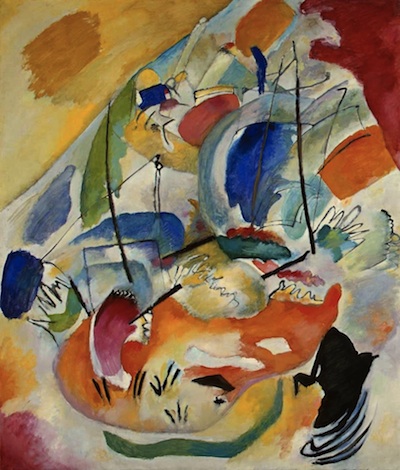
 Image of Kandinsky’s “Improvisation 31, Sea Battle” courtesy of the National Gallery of Art
“It’s too soon to be optimistic,” said President Obama during his most recent trip to the oil-hit Gulf of Mexico coast. As the disaster deepens (beaches in the tourist area of northwest Florida just saw the first sure signs of oil), I’m turning to Sea Battle at the National Gallery of Art. Not because there are grounds for any level of literal comparison, but rather because this picture’s ripping sense of rupture and effluence evoke the natural and political fall-out from the spill.
Wassily Kandinsky (1866 – 1944) was an abstract art pioneer. Born in Moscow, it was seeing a Monet masterpiece at age 29 that made him move to Munich. There he began Der Blaue Reiter (The Blue Rider) in 1911, a group of Expressionist artists clustered around the creed that creativity was inert in academic art and that an artist had a spiritual mission.
The Blue Rider trotted towards abstraction in art, but the trek was treacherous indeed. You see, art without a subject was an utterly revolutionary proposal at the time. Sure, in the first decade of the 20th century, Fauves and Expressionists had liberated color, Cubists had split objects into multiple planes and Futurists had challenged concepts of time. But for all this flattening of frontiers, until 1910 artists had stuck to a subject, however hard to identify.
The lyrical, mystical, color-shot canvas of Improvisation 31, Sea Battle (1913) hard-leans into abstraction and lays Kandinsky’s claim to being the first non-representational painter. But even here, what might at first glance appear formless and free is in fact more manicured than that (prep work for a painting like this might take months). The main motif is a pair of battling sail ships, tall masts as slim black lines, cannons blasting while waves roll under-keel. At the upper left stand the tall towers of an about-to-topple city.