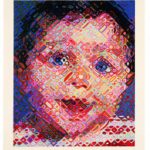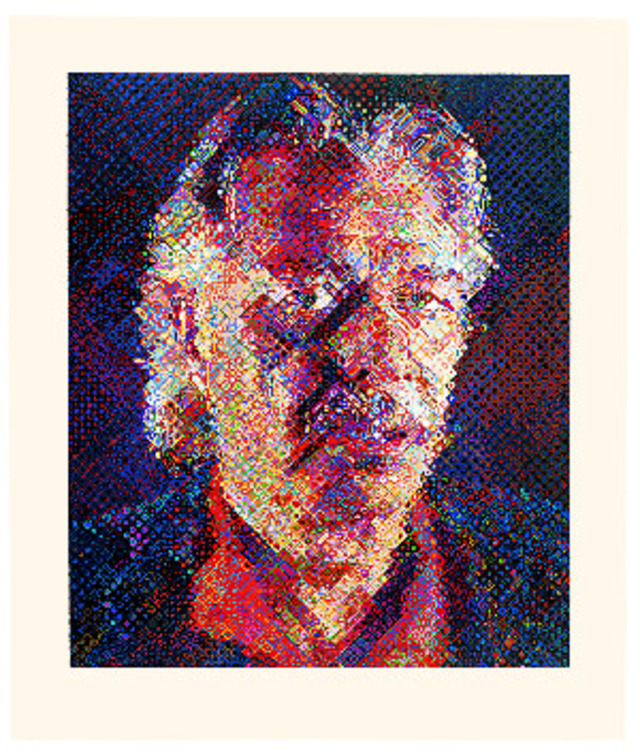
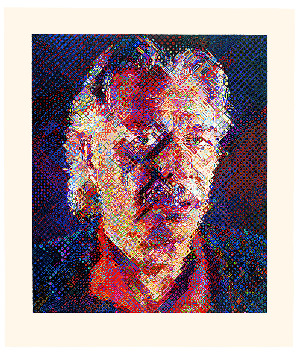
 Chuck Close, John, 1998. 126-color silk screen, 64 1/2 x 54 1/2 inches, edition of 80. Brand X Editions, New York, printer (Robert Blanton, Thomas Little). Pace Editions, Inc., New York, publisher. Courtesy of the artist and Pace Editions, Inc.
If you are a firm believer in the ethos that life is about the journey and not the destination, then you’ll enjoy Chuck Close Prints: Process and Collaboration, currently on view at the Corcoran Gallery of Art. This fascinating dissection of Close’s finished artwork raises the curtain on his creative process, showcasing his vast print work that ranges in technique, but never style.
While the exhibit contains Close’s highly colorful and detailed finished work, the real highlight here is the creative process that leads to the final outcome. While some might argue that by revealing the “man behind the curtain” you ruin the magic, Close himself — who wanted to be a magician as a child — believes this level of candor doesn’t ruin the illusion and that you’ll still be amazed by the trick.
“You see the logic, thought process, and record of decisions I made,” Close said. “Crumbs along the trail, Hanzel and Grettle style and [the viewer] can pick them up and figure them out.”
Known for his huge photorealistic portraits, Close learned and mastered several print techniques, experimenting with the grid he used in creating his paintings, and then started to highlight this important step in the process in his prints. Close created mezzotints, linocuts, silk screens and paper pulp art. When asked why he went from one technique to the next, Close explained that he doesn’t want to feel like he’s “plowed the same field too many times.” Print was a new way of thinking for Close. While painting is an additive process, many print works start the opposite way, making you think in the negative — a reductive process.
His prints are not small, averaging about four feet. Close’s paintings ranged upwards of nine feet, while the prints were reworked based on how much smaller the squares or marks could be while still containing the same amount of colors to maintain the spirit of the painting.