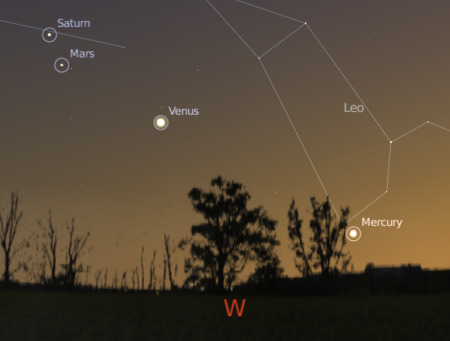
 Screencap from Stellarium, showing how the planets will look in the Western sky at 9 p.m. on Monday, July 26, 2010.
The dusk sky is still swarming with planets these days. With a clear sky and slightly cooler temps tonight, do some stoop-gazing (or backyard gazing, if your porch doesn’t face west), preferably with an appropriate beverage. By 8:15 p.m., Venus should be bright enough to see through the waning sunlight; Mars and Saturn will appear close together and slightly to the upper-left of Venus just after 8:45. If you have good binoculars, or a telescope and a clear view of the horizon, you’ll also catch Mercury to the lower right of Venus, next to the bright 1.35 magnitude star Regulus, just before they dip out of view at 9:15 p.m. Saturn will appear in the arm of the constellation Virgo, which includes the 0.95 magnitude Spica to the left, just slightly higher on the horizon.
At 9:30 p.m., turn around to the Eastern horizon and find the Full Moon as it rises. Looking up from there, you’ll find our seasonal companion, the Summer Triangle, with Altair closest to the horizon, Deneb up to the left, and Vega at the highest point.
>> Take an extended coffee break tomorrow and head to the National Air & Space Museum at 10:30 a.m. to meet the STS-132 astronaut crew (they flew aboard Atlantis to the International Space Station this past May) and Nobel Prize winner John Mather. After a presentation by the crew about their mission, NASM Space History Division curator Margaret Weitekamp will discuss the work that earned Mather the prize on the Cosmic Background Explorer Satellite. Free.