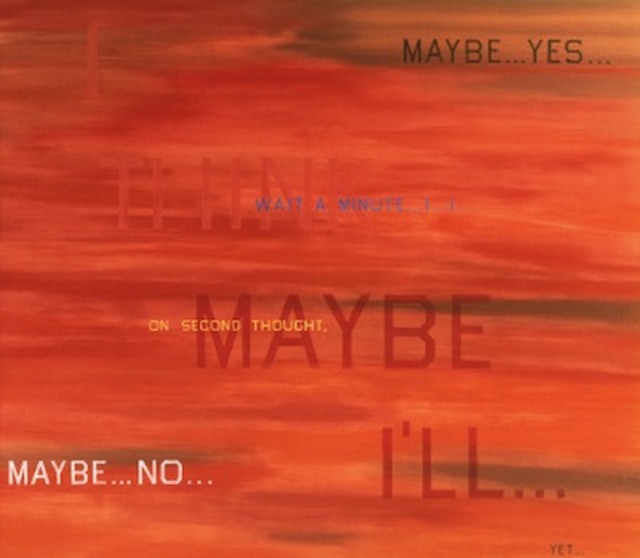
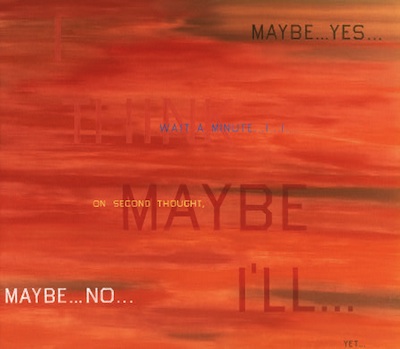
 Ed Ruscha, I Think I’ll. Courtesy of the National Gallery of Art.
Imagine that sweatshirt you gave to Pops for his birthday or the cookbook you selected for your sister at Christmas getting as much airtime and attention as the Cameron-Obama gift exchange that happened in July. For the Prime Minister’s first official visit to the White House, much was made of the of the gifts that were exchanged between the two leaders. Cameron clocked up credibility and kudos for his choice of an edgy, electric painting by British graffiti artist Ben Eine. As his color-popping Twenty First Century City crossed the Atlantic, Eine (a collaborator of Banksy’s and one of the premier artists of the street genre in England) had this to say: “It’s not the kind of recognition I seek or get every day, but Cameron seems quite a positive kind of guy and Obama’s a dude. I would probably have had issues if it had been for Bush.”
As for Obama, he pasted over previous poor form — an iPod for the Queen? — with a signed Ed Ruscha lithograph called Column With Speed Lines. Reportedly chosen because it’s red white and blue, the colors on both countries’ flags, the work is said to be worth an estimated $7,000.
Who might have dreamed up the inspired idea of regaling a Ruscha (b. 1937), d’you think? Some fingers point to Michael Smith, who hung one of the artist’s works (on loan from the National Gallery of Art) in the Obamas’ living quarters last year, when he was chosen as the decorator to adorn their White House. Smith is from southern California, so perhaps had an affinity with the artist: Ruscha is Nebraska-born, but considered a quintessential L.A. artist, having carved his career in the state.
I Think I’ll is the 1983 NGA piece that now hangs in the First Family’s living quarters. It’s a striking, streaky, blood-orange thing that possesses an unusual property: the longer you look at it, the more words and phrases slip up off its surface. There’s “I think maybe I’ll…” in large block letters scaling from top left to bottom right. Other fragments in smaller print (“Maybe… yes…”, “Maybe… no…”, “On second thought”) are scattered here and there. A tiny “Yet” almost drops off the bottom edge.