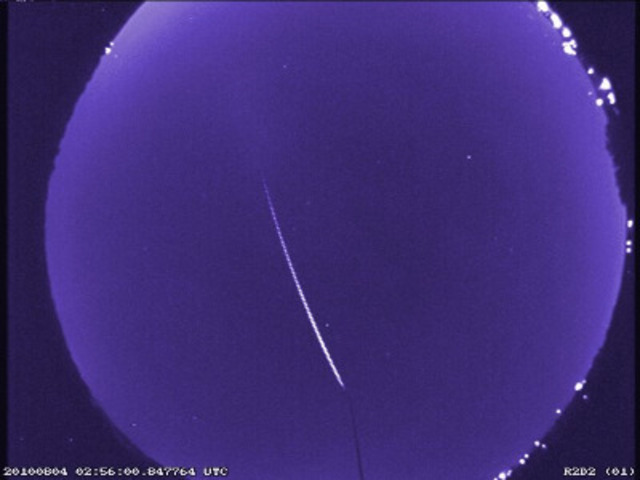
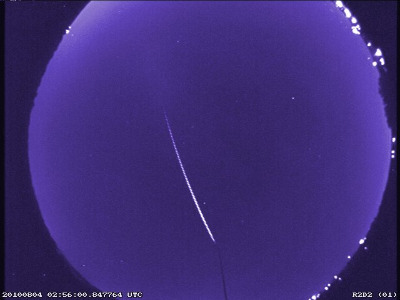
 Image of Perseid meteor that created a fireball brighter than Venus on August 3, 2010. Image credit NASA/MSFC/B. Cooke, via nasa1fan/MSFC.
Last week, we told you to keep an eye out for the Perseid meteor shower. Tonight and tomorrow will be the best nights for this year’s show, as up to 50-80 meteors an hour will reach Earth and burn up into fireballs in the atmosphere. You may see them as early as dusk — but for the real show, stay up late and watch until the early morning on both nights.
>> We’ve also been getting a nice treat at dusk every night as Mars, Venus and Saturn form a tight triangle in the Western sky. Just after the Moon sets a little after 8 p.m, you’ll see the bright “evening star” Venus appear above it; the sky gets dark enough for Mars and Saturn to come into view a few minutes later. Just to the upper left is the 0.95 magnitude star Spica, part of the constellation Virgo.
>> Get your space fix right now by tuning into NASA TV. Astronauts Doug Wheelock and Tracy Caldwell Dyson stepped outside the International Space Station at about 8:30 a.m. this morning on a second spacewalk to replace replace a failed coolant pump. One of the two coolant loops failed on July 31, so Wheelock and Dyson took their first spacewalk last Saturday, which lasted eight hours and three minutes, becoming the longest spacewalk in ISS history. If all goes as planned, a third and final spacewalk is scheduled for early next week to finish the job. Today’s spacewalk should last around six hours.