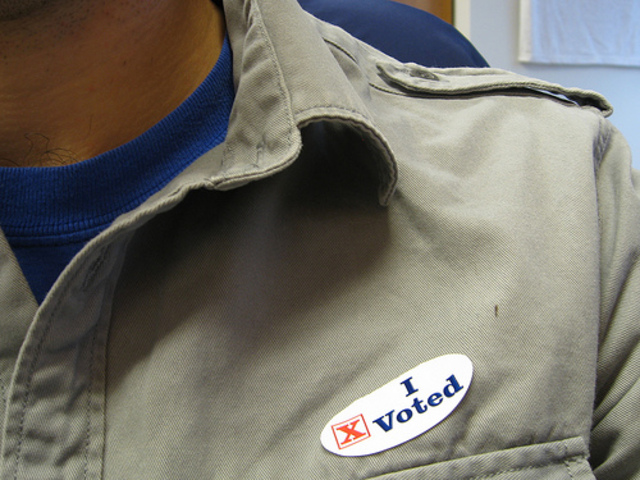
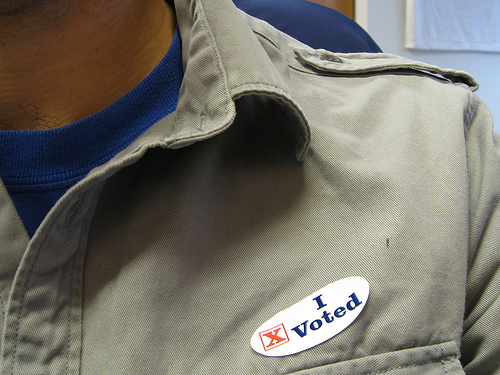
 Photo by voteprime.
We had mentioned last week that yesterday was the last day for D.C. voters to switch party affiliation in time to vote in the September 14 Democratic primary. The Washington Post reports today that nearly 2,600 voters in the District have made that change in 2010. Based on preliminary reports, the District’s Board of Elections and Ethics notes that 2,068 “no party” voters, 308 Republicans and “several hundred” Statehood Green party members had switched affiliations between the beginning of 2010 and yesterday.
But what’s 2,600 voters between friends? In such a tight race, such party-swappers (especially independent voters) might end up being split evenly between the two main candidates. Not to mention that the 2,600 figure dates from the beginning of the year, whereas we had no idea that Gray would be Mayor Fenty’s main challenger until April. Not satisfied with pure speculation about how many of those who have changed party alliance may go for Fenty or Gray, we dug into the results of the District’s post-Home Rule Democratic primaries to get a sense of what 2,600 votes actually means in the historical sense. The answer? Well, not too much.
Aside from the memorable 1978 race, in which Marion Barry rode a wave of popularity and defeated Sterling Tucker by a minuscule 1,564 votes to earn the party’s nomination, Democratic primaries in the District have not been what we’d call thrilling affairs. In fact, aside from 1978, you won’t be able to find a primary race that was settled by less than 8,000 votes. The closest you’ll get is Walter Washington defeating Clifford Alexander in 1974 by 8,351 votes (margin of 8.96%), followed by Sharon Pratt Dixon Kelly beating John Ray by 11,060 votes (9.09%) in 1990, and Anthony Williams defeating Kevin P. Chavous by 13,717 votes in 1998 (15.14%). The rest were total blowouts.
Of course, none of this actually means that 2,600 newly-minted Democratic voters won’t make a difference in this year’s primary. But it does kind of put into perspective what the news means: an interesting development, but hardly Earth-shattering for either candidate.