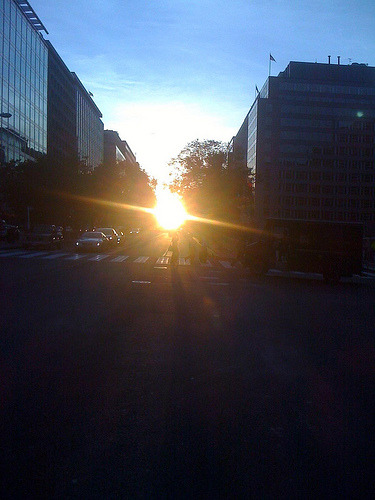
 Image og D.C. Henge in 2009 by Will Mitchell, via Creative Commons license.
Twice a year, the east-west streets of Washington, D.C. play host to the rising and setting sun. Most people are more familiar with Manhattenhenge, where the towering skyscrapers of New York City provide a spectacular frame to focus ones attention on the center of our solar system (blinding drivers and awing photographers in equal measure). The name was coined by popular astrophysicist (I just like typing that) Neil deGrasse Tyson — who will be speaking at Howard University next week — who wondered aloud if future archaeologists would dig up Manhattan and believe it had astronomical significance, with its architecture lined up to greet the sun, as Stonehenge does during summer and winter solstice.
D.C. and New York City experience this phenomena on different days, since Manhattan’s perpendicular grid of streets is tiled about 30 degrees off-axis, while ours lines up directly north-south and east-west. As deGrasse Tyson notes, the sun sets directly west twice a year, on the equinoxes. That makes it pretty easy for us to remember when our modest D.C. Henge occurs: Wednesday is the autumnal equinox. Since the sun moves only a smidge in the sky each day, we’ll actually be able to see it setting down our alphabet streets most of the week, but tomorrow will be the day to bring your camera and catch it between, you know, the awe-inspiring lobbies of a couple of ten-story law firms.