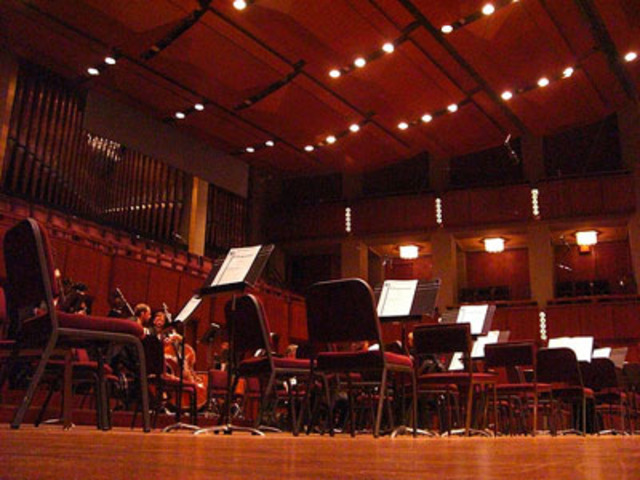
 Kennedy Center Concert Hall. (Photo by klea.scharberg.)
After three programs to open the season, the Christoph Eschenbach era at the National Symphony Orchestra is off to an excellent start. Like last week’s concert and, to a lesser degree the first week before that, in this weekend’s concert, heard last night, the NSO players sounded unified, energized, well rehearsed and brimming with confidence. Eschenbach’s choice of music was also, once again, engaging, as was the interpretative expertise behind it, showing the advantage of a veteran pair of hands. Eschenbach will not return to the podium of the Kennedy Center Concert Hall until January 22 (he will spend part of the fall in Paris, conducting a production of Hindemith’s opera Mathis der Maler), so tonight’s final performance of this concert of Mozart and Mahler is your last chance to hear Eschenbach at work this year.
The cancellation of remarkable mezzo-soprano Nathalie Stutzmann robbed us of a much anticipated all-Mahler program. Eschenbach chose to replace her set of Mahler songs with a Mozart symphony, but not one of the expected ones: like the Bruckner sixth symphony heard last week, the NSO last played Mozart’s Symphony No. 34 (C major, K. 338) in the 1980s. It is a bubbly work, especially in the light-hearted outer movements, and Eschenbach left it mostly unaltered by rubato but with a clear and dancing beat. The ensemble was fairly large for Mozart — one supposes because the players were already contracted for Mahler, cancellation or no — but larger orchestras were certainly known in Mozart’s time. Even with that many musicians on the stage, the pianissimo passages were deliciously soft and contained, especially in the mostly-strings slow movement. Although this was not really a historically-informed performance approach, the influence of that movement was felt in the crisp articulation and fleet tempi, especially in the rather madcap final movement.