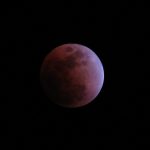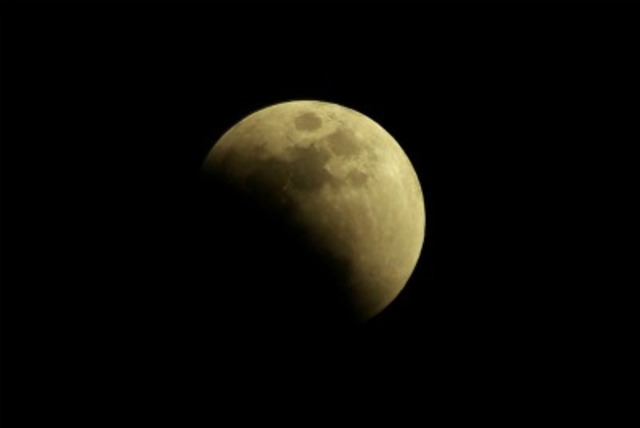
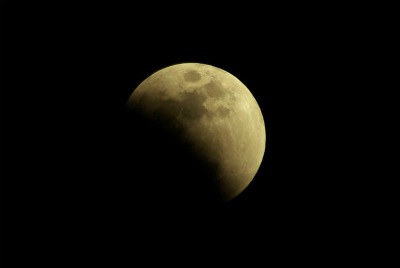
 Photo of February 2008 lunar eclipse by philliefan99.
We wrote about it last Monday, but wanted to remind you that tonight’s sky will feature a total lunar eclipse – the last one we’ll see until 2014. The moon will enter partial eclipse – that’s when it begins to enter the “umbra” of Earth’s shadow – at 1:33 a.m., reaching total eclipse just over an hour later at 2:41 a.m. You can see it brilliantly with your own two eyes – as it’s eclipsed, the moon will turn a dark red from scattered sunlight through the atmosphere, the colors helped along a bit by pollutants (but pretty pollutants!). If you have a pair of binoculars or a camera with hefty zoom lens (200mm or more), you’ll get a nice view of the craters, too. Don’t forget to upload your photos into our Flickr pool and tag them “lunar eclipse” so I know where to find them in 2014.
Tonight’s partly cloudy prediction for D.C. doesn’t bode well, just as clear daytime skies gave way to obscurity for the peak of the Geminids last week. NASA has a solution: tune into a live video feed from their camera at Marshall Space Flight Center in Huntsville, Alabama. If you’d like to know more about lunar eclipses, read Shelley Witte’s excellent summary at the National Air & Space Museum’s blog.
Aside from being the last total lunar eclipse for quite some time, one more piece of timing marks this astronomical event as a bit special: it falls on the winter solstice, the first time that has happened in 456 years. As the moments cross, cats will lie with dogs, my Dasani will become a 1787 Chateau Lafite and John Cusack will escort you to the nearest ark. (No promises.) Indeed, with the winter solstice being the day of the year with the least amount of sunlight, we can pretend that perhaps it’s an homage to the nighttime spectacle. Of course, the winter solstice here in the northern hemisphere is when the Earth’s tilt is furthest away from the sun in its orbit, the astronomical start of winter – the exact moment of which is actually 6:38 p.m. Tuesday evening.