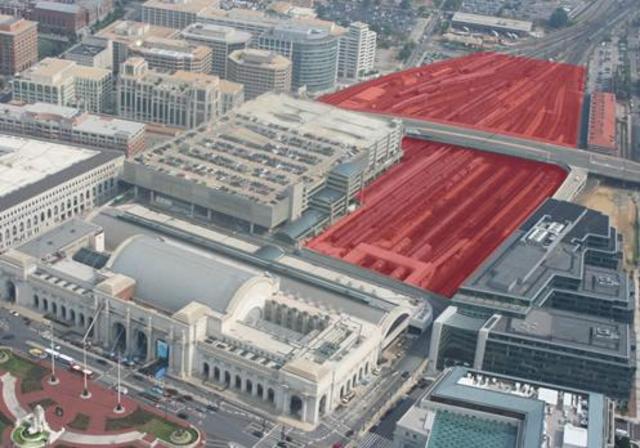
 Rendering courtesy Shalom Baranes Architects.
Ah, the Height Act — that singular piece of regulation, whose repeal, many would have you believe, would go a long way toward solving any number of problems that Washington currently faces: from traffic to housing, retail to population growth. Such opponents of the Act will certainly have cringed this morning upon reading this report in today’s Washington Post, explaining how a potential development over the rails behind Union Station which would scrape — or violate, depending on your perspective — the limit is yet again being slapped with accusations that it will “scar” the area. Oh, the horror, the horror!
Burnham Place, Akridge’s long-planned mixed-use plan for the space above the tracks adjacent to Union Station, has had to leap over several hurdles — for instance, as we noted nearly six years ago, “excavating an active rail yard is complicated and in some cases cost-prohibitive” — to even get to this point. But based on Jonathan O’Connell’s story, the biggest hurdle the now eight-years-old project has to clear remains the city’s height restriction:
Akridge’s taller building designs still require approval from the Zoning Commission and from the Historic Preservation Review Board, and they met some opposition at a Jan. 6 Zoning Commission hearing. Alma Gates, a member of the Committee of 100 on the Federal City, a local coalition, said the plan could “create prominent vertical scars” to the city’s sightlines. The National Capital Planning Commission called the proposal “inconsistent” with its interpretation of the Height Act. A number of Zoning Commissioners also raised concerns about the height.
Union Station’s Capital Hill neighbors, however, after a dozen meetings with the developer, backed the plan, as did Ward 6 Council member Tommy Wells. “We want to see that the buildings do not overshadow the existing residential properties,” neighborhood resident Rob Amos said at the Jan. 6 hearing on behalf of Advisory Neighborhood Commission 6C. “We do not see this project radically altering the vistas of our community.”
In short, there’s a developer — and hardly one, it should be noted, who is proposing a skyscraper — who wants to build a large, mixed-use development in an area which currently houses…well…rails, power lines and not much else. But instead of fulfilling what is obviously something that citizens are clamoring for, both the National Capital Planning Commission and the Committee of 100 on the Federal City would prefer to stick to an arbitrary interpretation of the Height Act, one which no longer even jives with the city’s Comprehensive Plan, thanks to the District’s Office of Planning.
I suppose it begs the same question that urbanists and developers have been asking now for years, for some time: how long will the Committee of 100 and the NCPC be willing to let good space sit vacant in their continued defense of the Height Act?