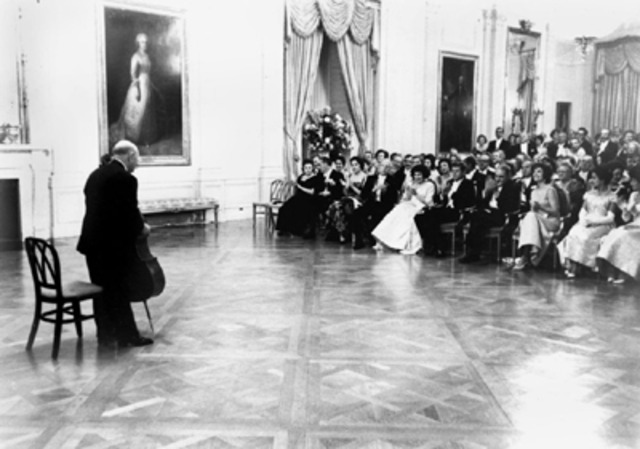
 Cellist Pablo Casals at the White House, November 13, 1961 (photo by Cecil Stoughton/The White House, courtesy the John F. Kennedy Presidential Library and Museum.)
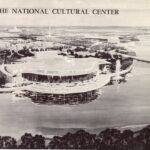
Fifty years ago, John F. Kennedy’s inauguration turned a generational tide in the United States, a watershed event being celebrated this month at the performing arts center named for him on the banks of the Potomac. Among those filled with hope for the future by the young president’s election were artists, writers and, not least, classical musicians, who welcomed his words about the importance of the arts to the life of the country. “In free society,” Kennedy claimed boldly in one speech, “art is not a weapon and it does not belong to the spheres of polemic and ideology.” Encouraged, it is generally believed, by his classical music-loving wife, Kennedy led by example, inviting the best musicians to perform at the White House for gatherings of the greatest artists of the day. At one such important event, Kennedy drew on his correspondence with the octogenarian Pablo Casals coaxing the outspoken Catalan cellist out of retirement — a musical silence that began as part of his protest against the fascist government of Franco in his native Spain — for a legendary recital at the White House. In a gesture meant to open the doors to the nation, a recording of the concert was later released.
On Tuesday night, the cellist’s widow, Marta Casals Istomin, presided over a Pablo Casals Tribute Concert in the Kennedy Center Concert Hall, a recreation of the program of this recital led by perhaps the most recognized figure in classical music today, cellist Yo-Yo Ma (like his recitals in 2007 and 2006 practically guaranteed to sell out quickly, even when he barely plays anything).
“We are here to recapture,” Casals Istomin said elegantly, “that brief moment when music was center stage in the nation’s capital.”