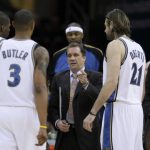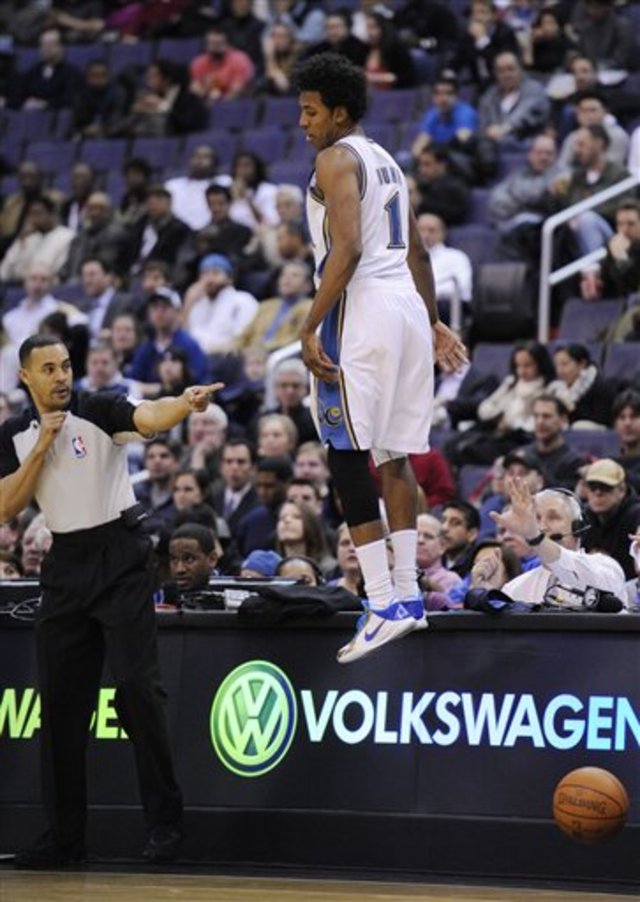
 (AP Photo/Nick Wass)
To satisfy your Wizards fix, DCist is teaming up with Kyle Weidie and Rashad Mobley of Truth About It, who will take turns penning a column on Washington’s professional basketball team every week throughout the season. You can read Kyle and Rashad on all things Wiz here.
Earlier this season, after who knows what number post-game press conference where he had to explain a frustrating loss, Wizards coach Flip Saunders exited the media room with an impassioned step. The media followed his path up until the point where Saunders carried forward to his office, per usual, while hurried members of the press took a quick turn left into locker room to interview players. Before disappearing around the corner, in a moment where he probably thought he was alone, Saunders let out a loud expletive, both rhyming with and feeling down on his luck.
Moving to his press conference after Tuesday’s home game against the Denver Nuggets — the Wizards’ 31st loss in 44 games on the season — Saunders’ demeanor was different. He wasn’t exactly a defeated man — Saunders’ often conveys a sleepy-eyed, subtle calmness — but he was more a coach resigned to a situation which he often likes to point out that he didn’t sign up for. He highlighted more what the Nuggets did in building confidence to beat a downtrodden, rebuilding franchise, rather than what his own team did, or didn’t do, in losing yet again. Saunders didn’t seem as angry at the loss as he did on Monday night in New York, but more faced it as a matter-of-fact. Afterward, as he went through his exit routine with the media following on their way to talk to players, Saunders didn’t drop any F-bombs. He just gently rapped his hand along the photos of Wizards stuck to the wall as he plodded toward to his office, seemingly lost in his own thoughts.
There’s no question, Saunders and his staff put in work. From providing custom iPads to players filled with the playbook and state-of-the-art situational statistical analysis available to coaches during games to keeping in constant contact with players through the art of the text message during in-season and off, as well as traveling to the players’ summer time haunts to work them out and touch base, Saunders embodies the type of outreach that many D.C. public schools could use. The coach is always teaching, relentlessly. But is his passive style the right mesh for a franchise trying to establish a new culture?