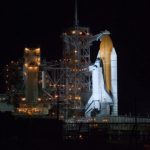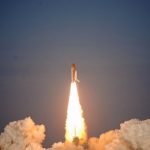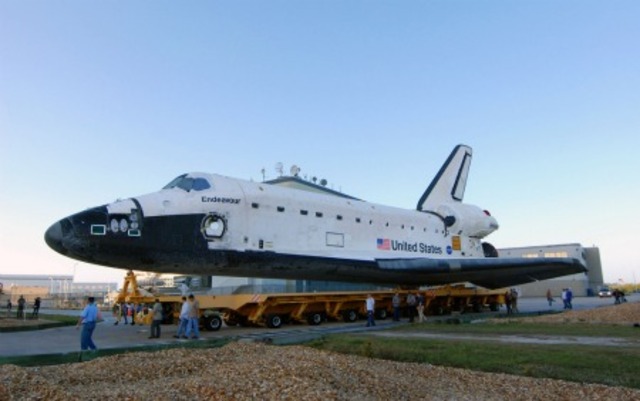
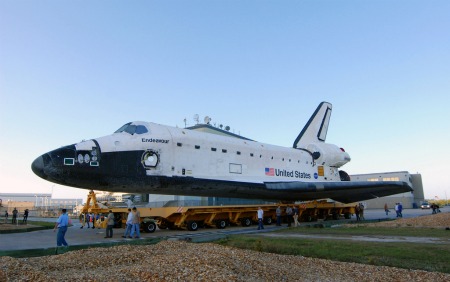
 Photo by Heather Goss. Space shuttle Endeavour performs its last rollout from the Orbiter Processing Facility before its April 19 launch.
Good morning, space fans. I know it’s been awhile since we posted a Look Up column (every winter, space takes a backseat to photography, as you know), but we have a few good bits for you today. Read on for once-in-a-lifetime launch viewing opportunities, how the Japan earthquake permanently altered the Earth, and some debunked space myths.
>> First, you have from noon today until noon tomorrow to put your name in the lottery to see the last launch of space shuttle Endeavour up close and personal. NASA is organizing another Tweetup, offering two-full days of activities — including a tour of Kennedy Space Center, presentations by astronauts, close-out crew, and other NASA personnel — and finally, a viewing of the launch from NASA’s media site. The event is free but you have to pay your way down there. I went to the first launch tweetup (with my mom!) and had an incredible experience. If you don’t get in to the tweetup, you can still get down there to see it on April 19 — indeed, it’s a night launch, making it even more of a must-see. We wrote up some tips on making the trip last year. The not-totally-confirmed launch of Atlantis wraps it up for American human spaceflight indefinitely in June.
>> The human effects of the 8.9 earthquake in Japan last week are horrific and still being determined. What’s more clear are some of the physical effects the tectonic shifting did to the Earth itself. Read this fascinating article at Space.com about how it “has shortened the length Earth’s day by a fraction and shifted how the planet’s mass is distributed.” Our days are now 1.8 microseconds shorter (and here I was getting excited about longer days) and the Earth’s axis moved 6.5 inches. Geophysicist Richard Gross at NASA’s Jet Propulsion Laboratory explains, “this shift in the position of the figure axis will cause the Earth to wobble a bit differently as it rotates, but will not cause a shift of the Earth’s axis in space.” Among the mass-shifting by the earthquake: Japan’s main island may have moved as much as eight feet.
>> Discovery’s Bad Astronomer explains why you can stop worrying that the “supermoon” caused the Japan earthquake.
>> Sky & Telescope explains how you can see (with a clear sky and open view of the western horizon) Jupiter and Mercury dance together early this week. Oh, and that “supermoon”? We also call it the Worm Moon (and a bunch of other things), and it’s one of the two times per year it rises due east, lining up with the monuments on the Mall. Shutterbugs can join in meetups at the World War II Memorial or at the Washington Monument to get it on camera.