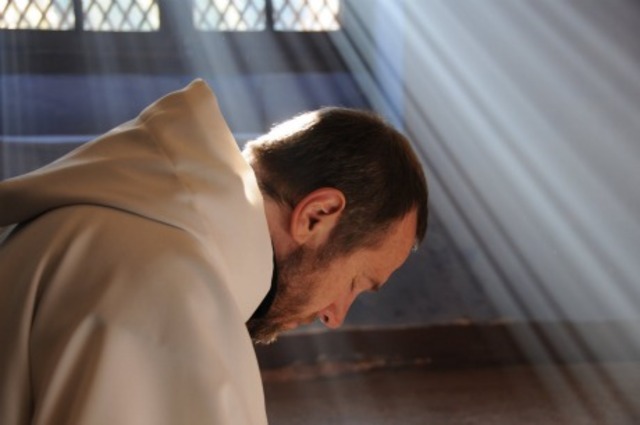
 Not a single note of incidental music plays on the soundtrack to Of Gods and Men. But just because every sound we hear is generated onscreen doesn’t mean that director Xavier Beauvois isn’t using sound just as strategically as the most grandiosely scored films. Like the best musicians, in fact, Beauvois knows the power of silence, and employs it liberally. The result are long, languorous stretches in which the eight Trappist monks at the center of the story go about their daily tasks, or roam the countryside contemplatively.
What sounds potentially dull is anything but, because these moments of exhalation are necessitated by the tension and quiet conflict in the film’s more narratively rich sections. That countryside they wander is in Algeria, where the French monks’ abbey resides, at the edge of a small, mostly Muslim village. Their religious differences with their neighbors are largely irrelevant: they sell the honey made in their gardens alongside the villagers in the marketplace, and provide the residents with the only local option for medical care — free of charge, of course. They have their place in the village structure, and have for decades. But this is the mid-’90s, and Algeria is in the midst of a civil war, as a group of fundamentalist Muslims attempt to wrest control of the government from the more moderate ruling party. The monks’ religious and racial differences from these guerilla groups is more of an issue.
The monks find themselves at an uncomfortable crossroads: give up their lives here at the Abbey to flee back to France, or risk giving up their lives literally to the violence that seems all too near. Much of the film focuses on their internal debate, as they carefully weigh the reasons to stay or to go, as their abbot, Brother Christian (Lambert Wilson), presides over the rest of the group with a calm that helps to soothe the more anxious elements in the group. His unflappable nature, and seemingly endless capacity for forgiveness, form the bedrock upon which the abbey and the film reside.
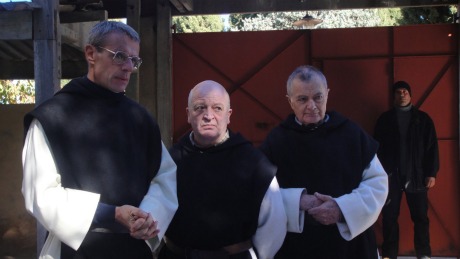 He’s so unflappable, in fact, that for a time he manages to maintain a tense détente with the extremists. When they arrive at the abbey, rifles at the ready, looking to take away their doctor, he stands his ground. Christian reads daily from the Koran as well as the Bible, and in many ways knows it even better than the these men, giving him both leverage and their grudging respect. By the time they leave, without the doctor, they are apologizing to him for the disturbance, coming as it has on Christmas night. Over time, these men even begin to bring their wounded to the abbey, knowing the monks will treat them without judgment.
Whatever else is going on around them, the monks maintain their daily routines: laboring in their gardens, gathering wood for the fires, prayer, and singing. Every day there is singing, and the haunting chants provide the film a musical outlet that fills the absence of a score. The alternating silence and sacred music also sets the film up for its most deeply affecting moment. In a time of great worry, the doctor puts on a recording of Tchaikovsky’s Swan Lake as they sit around the table. The sweeping romanticism and the dark passages of the work become a kind of catharsis for both the monks and the viewers. It’s a scene that has the potential for naked manipulation on Beauvois’ part, but the film has earned the moment, melodramatic though it may be.
This story is based on true events, so the outcome may be familiar to some going in. Beauvois neither discounts nor relies on this familiarity. Where the plot is going for the monks isn’t his focus. He’s more concerned with who they are, and what true grace looks like amid hate and violence. Religious differences, the film point out, are only a problem for those who make the effort to make it one. Christian’s final monologue makes an elegant and moving case for tolerance that gives this quiet film the philosophical weight to match its simple structural and visual beauty.
—
Of Gods and Men
Directed by Xavier Beauvois
Written by Xavier Beauvois and Etiene Comar
Starring Lambert Wilson, Michael Lonsdale, Olivier Rabourdin
Running time: 122 minutes
Rated PG-13 for a momentary scene of startling wartime violence, some disturbing images and brief language.
Opens today at Bethesda Row, Shirlington, and Cinema Arts.