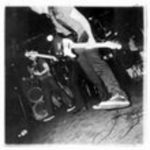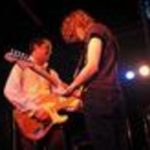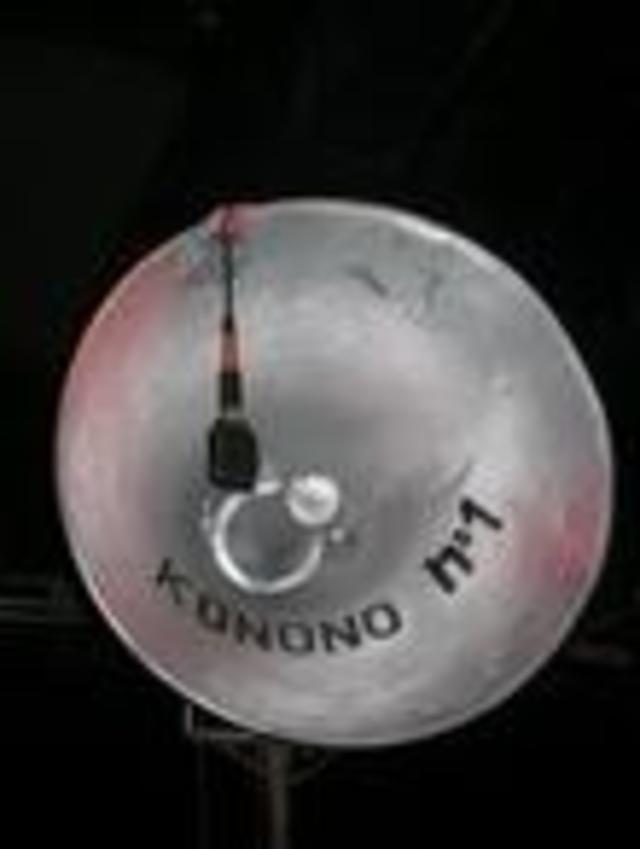
 Review and photos by DCist contributor Paul Ghosh-Roy
They don’t speak English. Their sound system consists of PA style loud speakers draped with mics. They play thumb pianos. The guy who formed the band was born in 1933. They also have a track produced by Timbaland on Bjork’s new album. Oh yeah, and they played the Black Cat on Friday night.
What to make of all this, you ask? Well, it’s Konono No. 1, son, so act like you know. Coming to us live and direct from Kinshasa, Democratic Republic of the Congo, this seven piece ensemble brought their unique brand of fuzzed out Bazombo trance music to Washington, D.C. on Friday. Astute world music heads will note that that this is, in fact, the second time that Konono No. 1 has played the Black Cat, the other being a hot July night when the air conditioning was broken. Mercifully, this time the heat came only from the music.
A brief history of this phenomenon is as follows: in the 1960s Mawangu Mingiedi forms the band in Kinshasa, after moving to the city from the Zairian countryside; Kinshasa was too loud for the traditional, acoustic likembes (thumb pianos) to be heard over the urban din, so the band scares up a primitive sound system and electrifies the likembes with homemade(!) mics; sound system is so bad that sounds are all completely distorted and a new sound is born; in 1980 band is “discovered” by The White Man after Crammed Discs producer Vincent Kenis hears the band’s sole recording made by France Culture in 1978; in 2004 the band records Congotronics and Western media creates a huge buzz; band tours Europe; in 2005 “Congotronics 2” compilation CD is released, band tours Europe, America and Japan; in 2007 band records “Earth Intruders” with Bjork; April 29, 2007, Konono No.1 plays Coachella in Indio, California; May 4, 2007 DCist attends Konono No.1 show at the Black Cat in Washington, DC.
So does the band deserve all the buzz and hype? Yes, and the reason is that this band is authentic. They play music and don’t worry about their haircuts. The front man was wearing sweat pants, a t-shirt and a fanny pack for Christ’s sake. And it is the music we should focus on, as their distorted style created a unique and utterly new sound, unknown to the Congolese or anyone else. Yet at the same time, the music is completely familiar — familiar to Congolese and Angolans as, albeit fuzzy, Bazombo trance music, and familiar to Westerners for the typical reasons of our projections onto it. Western journalists have described the sound variously as like “avant garde,” “kraut rock” and “electronica.” Mawangu Mingiedi says, “I didn’t know there was such a thing as electronic music.”