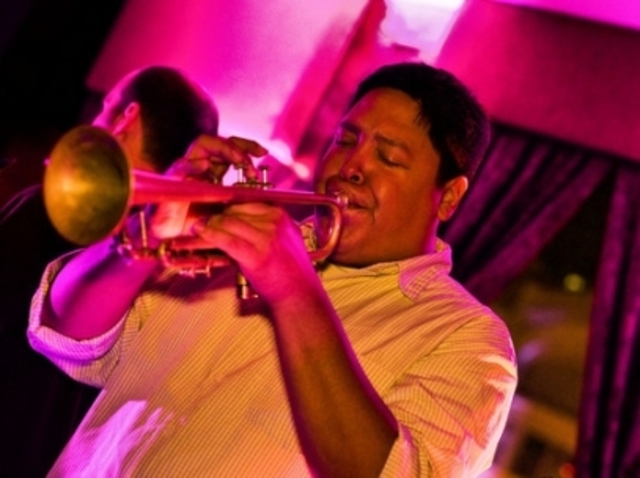
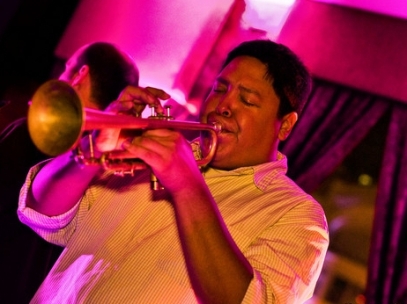
 Joe Herrera.
Seeing a jazz gig in the District that doesn’t feature Joe Herrera is almost a challenge. The ubiquitous trumpeter is at the center of the city’s burgeoning jazz scene and plays an important role as both bandleader and sideman, co-directing the fine Bohemian Caverns Jazz Orchestra with saxophonist Brad Linde on Mondays, backing master griot Cheick Hamala Diabate at the Bossa Bistro & Lounge on Tuesdays, jamming with talented young saxophonist Elijah Balbed on Wednesdays and Thursdays at the Bayou, and playing one-offs with Thievery Corporation saxophonist Frank Mitchell, Jr. In March, Herrera and guitarist Rodney Richardson launched the Sunday Jazz Lounge series at Twins Jazz, which showcases many of the area’s brightest young talents, plus he is a core member of keyboardist Will Rast‘s Funk Ark, which has just returned from a series of showcases at SXSW. Oddly enough, Saturdays are the only regular night off for this busy jazzer.
A native of Yuma, Arizona, Herrera began his musical journey at age 10, when he wanted to play the saxophone, but instead started on the trumpet because his father already had one. He became serious about music as a freshman in high school and would often raid the record collection his band director kept. Classic players like Miles Davis, Freddie Hubbard and John Coltrane caught the young musician’s ear, and from there, his interest took off. After studies at Mesa Community College and Arizona State University, as well as stints as a musician on cruise ships, he began working regularly in and around Phoenix. An opportunity then arose for Herrera to move to D.C., which he did in 2003. He formed his first group, Joe Herrera’s Landscaping Crew, in 2005, which featured area regulars Matt Rippetoe, Bobby Muncy and Anthony Pirog. Things have only gone up from there.
There are many ways to account for Herrera’s success, the foremost of which is his talent as a player and ability to adapt his skills to a number of settings. He also straddles the line between musician and presenter, often looking for opportunities to show area talent in a new light. In addition, his imposing build conceals a genuinely affable and kind person who engenders a community vibe. These are just a few of the reasons why DCist decided to ask Herrera about his career and the state of jazz in the nation’s capital.
You are equal parts player, bandleader, and now you’ve also gotten into presenting and producing music. What drove you to take on all these roles, and how does your experience in one affect the others?
One thing leads to another. I am an active trumpeter and am constantly around other musicians. So things just sort of happen. As you know I am a sideman in many groups, which I like to do. It keeps things fresh and forces me to go in different directions. I can’t play the same with Cheick as I do with the BCJO. The beauty of it is that I can take how I would approach one gig and take it over to the other gig, opening up lot of musical oppotrtunites in my little brain. I also love being a leader of a band. I have always loved writing/arranging my own music. When I moved here in ’03, it just took time to find people that I wanted to have in a band. Leading a band is hard work, but rewarding. If you do it right, it helps you get established. It also makes you become a presenter of music. You are offering this music to the world. It’s great.
I have also been involved with some producing lately. I was the producer on Rodney Richardson’s debut album and I helped, unofficially, produce The Funk Ark’s new record, which is coming out on ESL Records this May. I have also produced shows at at various venues in D.C. One example is a show a produced at the Rock and Roll Hotel a while back featuring Bio Ritmo, Cheick Hamala and The Funk Ark. It sold out! Also, I am the horn director/producer for an upcoming show at DAR, The Chocolate City Soul Review, featuring the reunion of James Brown’s Band, Funky Lady Divas and The Impressions. I don’t teach lessons or at school, so I need to be as active as I can as a musician. It would be really hard to just be a trumpet player.
You play in many different settings. What is it about your approach that allows for that versatility?
I think you need to understand the music you are playing. You need to know what is appropriate and what isn’t in the setting. Certain music calls for certain things. I know that sounds “duh,” but it’s true. You have to know your role in the band. Sometimes your role is the front man who plays the big solo. Other times, it’s being a background supporter. When I improvise in, let’s say, a quartet or some sort of jazz aggregation, my approach is way different than if I was soloing in a pop band, or salsa, and vice versa. It took me some time to understand that. I still have to be aware of it today. I need to remind myself of my role in whatever musical situation I am in.
How do you see your career progressing? What are things that you hope to focus on in upcoming years?
I have been very fortunate in my life. I have had the opportunity to play, record and travel with amazing muscians from all over the world. If I can keep this up I’d be happy. As long as I keep working hard and being honest with myself I can’t see how it won’t just get better and better. We all have dreams coming up as jazz musicians to be touring, cutting records, making honest music. I may not be on the road with Chris Potter, but I am doing okay and I am happy.
I am focusing now on two records I hope to have out by the end of the year. I have been meaning to record the Landscaping Crew for a while, but I have been so busy lately. As soon as I am done tweaking the music, we will record it. I am also working on a solo trumpet record. I do a lot with electronics. This solo record will be an example of that. Of course, my focus is also with every project I lead/co-lead. The BCJO has been a huge success. Thus far, the Sunday Jazz Lounge has been a hit. Focus Daniel-san.
One impressive aspect to D.C.’s jazz scene, especially among younger players, is its strong sense of community, and you are at its center. How do you think this came about, and what can the scene do to maintain it?
There really is a sense of community here in D.C. There are so many good musicians here. One thing I think that keeps D.C. so hip is that everyone is nice. There aren’t many egos and vibes amongst the musicians here. Military musicians, Howard, UDC and UMD alums and student musicians, transplant musicians, young and old, new and staples. All vibe well and respect each other. Musicians here are eager to play and have sessions. It’s so great going out hitting up multiple venues and seeing your boys or girls and playing music with them. I don’t think I am the only one that feels that way. It’s great. Also I’d have to say having regular gigs at clubs helps that too. Places like Twins, Bossa, HR-57, Bayou, Bohemian Caverns, and even Blues Alley can really help contribute to the jazz community by hosting regular nights. The Bohemian Caverns Jazz Orchestra, I feel, has helped develop that as well. Where else in D.C. are there 17 musicians playing in one room? Talk about community. We keep this going by continually being respectful of each other and by making good music.
How did the idea for the Sunday Jazz Lounge come about?
Rodney and I were talking about doing something for a minute. We thought Twins would work out well. We knew they didn’t do steadies there, but what an opportunity to bring them more business and create a steady on a Sunday? Rodney then had the idea to start off the night presenting a different guest soloist each week. The soloist would have the first 15 to 20 minutes of the set to themselves to perform whatever they wanted. The rest of the set would feature our quartet with Eric Harper on bass and Dave McDonald on drums. The second set would feature the quartet with the guest soloist sitting in on a few tunes. We felt this would offer the listener an added bonus for the night, as well as set us apart from the regular gig.
How did you and Rodney choose the particular soloists involved?
Unaccompanied performances are unorthodox for many instruments in jazz. We came up with a number of people we wanted to ask. There are so many great players in the D.C. area, having to narrow it down to four people was challenging. Fortunately, everyone we asked was happy to participate. We also wanted to vary the instrumentation of the soloists. All of the musicians are accomplished on their instrument and exhibit commanding strength.
Are there plans to continue the Lounge beyond March?
We would love to keep this going. Unfortunately, Twins has dates booked on Sundays in April. We are talking with them about another month in the future, or even a different day of the week. We are also exploring the ideas of different venues, including “house concerts.” We just want to keep the hang and energy going. It’s only been three Sundays, but we feel like it’s already a hang, and people are proving it by showing up. It would be a shame for Twins to sleep on this.
Joe Herrera performing with the U Street All-Stars at CapitalBop‘s Jazz Loft: