 Imagine that, out of the blue, a resume or CV crosses your desk. It lists the individual’s educational credentials as having completed a bachelor’s degree in French, studied at the Sorbonne and recently obtained a J.D. from George Washington University. What would you project as the the person’s probable career path? The State Department? Maybe something on K Street or in academia?
How about underground rapper?
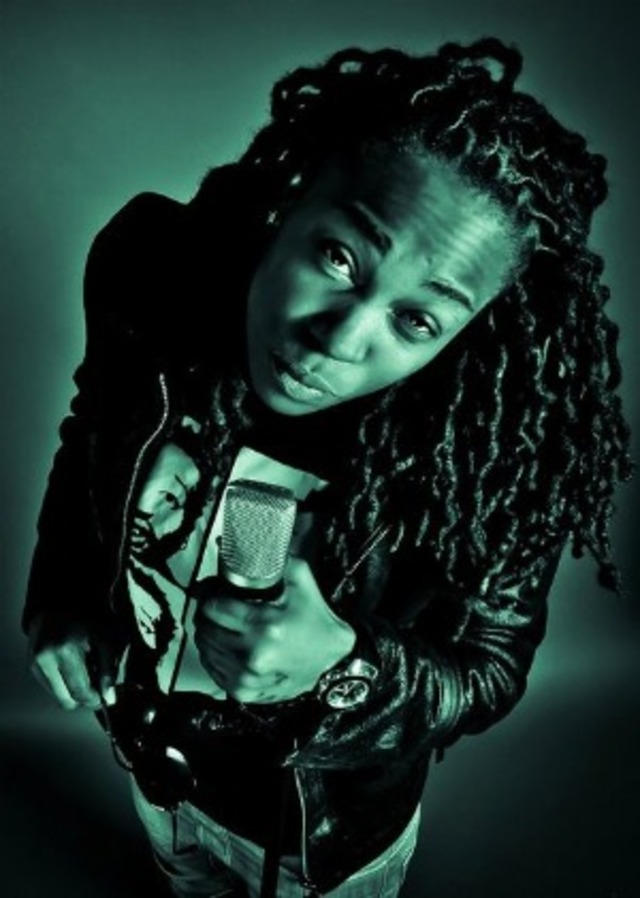
It might seem a little far-fetched, but Amanda Carter is charting such a course. The Harrisburg, Pennsylvania native first arrived in the DMV in 2001 as an undergraduate at Howard University. On campus, she took part in MC competitions, spent numerous hours freestyling with friends in dorm rooms and obtained her current moniker, 330, which is a play on her March 30th birth date. After spending six months in France, she came back to the States with an expanded perspective on hip-hop, but also an idea about going to law school since it seemed like the “right thing” to do. Once that three-year hell — in which her notepads were filled with rhymes as opposed to lecture notes — ended, Amanda knew she needed a more creative outlet than the legal field to express herself.
But hip-hop isn’t necessarily the most appealing avenue, especially when you identify yourself as a gay woman in a male-dominated industry that, well, has a less than stellar reputation as it pertains to the treatment of both women and gays. Regardless, 330 refuses to shy away from themes that may not instantly translate in to record sales. She recently released a mixtape album, Sorry I’m Late, which highlights her mental dexterity and encompasses her wide range of thoughts and feelings.
A few weeks ago, we caught up with Ms. Carter to discuss what it’s like being 330:
So how did you get into rapping?
I was a little bit of a class clown and I was totally amazed by how I could put words together in my head and make them rhyme and make other people laugh. I remember taking off my point shoes, freestyling after ballet class as a kid. At Howard, I would sit in my dorm room and freestyle for hours with my friends. We’d go in the Yard and make a little cypher. We did a program called ResFest at Cramton Auditorium. That was my first time on stage. I’m a nut. There were three rounds. The first round you had to do a spoken word piece. My poem was off the chain. Second round, we had to pull a word out of a hat and freestyle about it. I totally froze up. Everyone was kind of laughing, but I had a good attitude about it.
Who are some of your favorite artists out now?
CeeLo Green is one. Outkast and Jay-Z are others. Philly is a heavy influence on me. I love Beanie Sigel and Freeway. I really love how Freeway’s style is entirely unique, you can’t name anyone who sounds like him. His voice is literally an instrument and he’s aware of it. He plays with his voice, his intonation, his tone, his delivery. Beanie is the total opposite. His vocabulary is elementary but the way he delivers the words is so forceful that you look past that. I’m a fan of a few female rappers like Foxxy Brown, Rah Digga and Lauryn Hill when she was doing her thing.
Do you come across people who want to paint you as simply a “female rapper” and, if so, what do you say to that?
I do come across that, but people don’t voice it to me. I try to let my work speak for itself. I feel sorry for a lot of female rappers. You’re either a “conscious” female rapper or the hood chick/sex symbol. I’m neither of those. I’m somewhere in the middle.
As an artist with no big-name company behind you, how much time are you able to devote to music? In short, do you have a day job?
I am working a part-time, tutoring kids every day. My day is pretty busy, even though I’m working part-time. I get up in the morning, apply to 600 jobs, run errands, write music, look for beats, book shows and then go to work. I come home, apply to jobs, go to meetings, meet musicians. Things like that. I wish I had a full-time job.
But it sounds like you pretty much do. Given your background particularly as it relates to law school, do you see that as being advantageous in your musical pursuits?
It’s definitely an advantage. When I tell people I have a law degree — and it shouldn’t be this way — they listen to me more. They’ll take me a bit more seriously than they would the next person. People try to fuck you over less. ‘Oh, she knows something, she might sue me.’ I’m fully aware that some artists might come at me like, ‘What are you doing? You aren’t from the ‘hood. You have a law degree. Practice law, get out of the rap game.’ I’m fully aware that people will come at me like that, but I just want to be the best me I can. I want to develop myself artistically, intellectually, academically and spiritually.
With hip-hop music, drawing from your experiences to create rhymes is held paramount. Given your experiences, how do you draw from them to create your art?
I try to put a little intellectual twist on my lyrics. I guess that’s the law school part. I like to think of my rhymes as having a little analytical aspect to them. I kind of break things down. My metaphors aren’t necessarily short, sometimes they’re extended. As far as my time in Paris, it was only a semester, but while I was there I didn’t hang out with French people. I hung out with west African kids. My closest friend’s friends were musicians and producers. We would have crazy cyphers in French, English and Wolof. That definitely influenced me. Sometimes American rappers are choppy [with their delivery]. But when these people rapped in Wolof, they had constant flow. It was amazing. I try to incorporate that [flow]. My background is in the arts — piano lessons, theater classes, ballet, acting. I want my music to be art, not just me telling a story over beats. I want it to have an artistic element to it.
Do you feel you’re accomplishing this objective?
I think so. I’m trying to make my music colorful. I’m a pretty diverse person. I have some tracks where I’m like, ‘Ha, ha, ha! I fucked your girlfriend.’ But I also have some tracks where I’m talking about gentrification in D.C. I kind of have a lot going on and I want my music to be a reflection of me.
In one of our pre-interview communications, you mentioned you had performed for several major label executives. What was that experience like and would the label life be something you’d want?
It was great and I got good feedback. One of them said, ‘You’re dope. This is real hip-hop. It’s no “Stanky Legg“.’ But another label rep said, “You’re dope, but I’m in the business of selling records. And if that’s what you want to do, you have to switch up your content.” [The push to switch up the content] could mean a lot of things. I’m not talking about “Stanky Legg” dances but I am talking about women. I’m not going to talk about dudes if I don’t know anything about dating a dude. I’m sure he meant a lot of things by it, but I can’t swing it if I’m not doing it independently. I’m an Aries; I’m an individual anyway, so I don’t know [if signing with a major label would be a good thing].
Hip-hop can be very territorial and although you’ve been in the area for a while, have you found it difficult to get a foothold in a city where you’re technically an outsider?
I’m going to rep Harrisburg, D.C. and Virginia in my rhymes. I was born and raised in Harrisburg, lived in D.C. for five years and have lived in Virginia for four. For the people who were born and raised in this area [but not in D.C. proper], it kind of sucks if you live super close to D.C. and people get offended when you claim D.C.
Despite this, what is the network of artists like in the area? How do you find people to work with?
It’s kind of like magic. You’ll go to a venue. You’re one of the artists on the lineup, you perform, you kill it, you step off stage and people say, “Oh my gosh, that was amazing. You ripped that verse, we gotta link up.” This is what I do. I’m exchanging numbers and we keep in touch. If I hear of a great opportunity, I’m going to also tell someone else who’s talented and hungry and professional. My experience thus far is that everyone is pretty much on the same page.
How important is it to you to have name recognition in this area in an age of SoundCloud and worldwide music sharing?
It’s definitely important. I want people to know my music here and be proud of it. I want them to say, “She’s not necessarily from here, but she lives here. She’s influenced by us.” It might not seem that way since I’ve been performing mainly in Baltimore, Philly and New York, but it’s very important.
At the end of the day, what would you like the effect of your music to be?
The negative comment from the label executive pissed me off a bit, but I really appreciated it. At the same time, though, [switching up my content] isn’t something I want to do. You have to remember there is a group of people like me. There is a group of gay girls who want to hear music about themselves. And I don’t just want my music to be “gay” music. I want it to appeal to everyone. I’m going to tell my story which also happens to be someone else’s story. People appreciate that.
330 will be performing tonight at Bohemian Caverns along with headliners, The CooLots and M!das. $10. 9 p.m.
Photo by: S. Deneen Photography
Styled by: Shannon Gardner