Martin Austermuhle
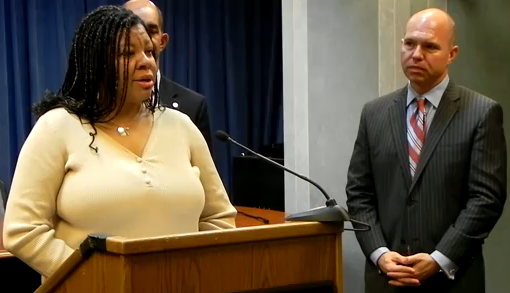 Nardyne Jefferies and David Catania unveil the city’s legislative response to last year’s South Capitol Street shooting yesterday.
Anytime something dramatic happens in the District, the D.C. Council tends to respond dramatically. But in response to the South Capitol Street shooting that left four teenagers dead one year ago, Councilmember David Catania (I-At Large) opted to take his time to craft a legislative response.
The final product, known as the South Capitol Street Tragedy Memorial Act of 2011, was unveiled yesterday at a ceremony commemorating the single deadliest killing in the District over the last two decades. Joined by colleagues Tommy Wells (D-Ward 6), Sekou Biddle (D-At Large) and D.C. Council Chair Kwame Brown, Catania outlined the six-part legislation that seeks to revamp the city’s behavioral health system so that at-risk youth can be more easily identified and treated.
“The mental health needs of the District’s youth have been chronically underserved,” explains a website set up by Catania to break down the details of the legislation. “The legacy of underinvestment in youth mental health in the District is the cornerstone of the failed system that makes tragedies like South Capitol Street possible. The legislation requires schools to study and implement measures that ensure that children who should be in school are in school. The connection between a future life of crime and unmet behavioral health needs as a child is well documented.”
As a hint to how serious the mental health challenges for youth in the District may be, consider this — a 2010 report by the RAND Corporation [PDF] estimated that 72 percent of adolescents enrolled in Medicaid in the District who are suffering from depression are not being properly treated. Moreover, the report stated, “gaps in surveillance surveys made it impossible to estimate levels of potential unmet need among children with severe mental health conditions.”
The District isn’t adequately addressing the problem, either. Though the city leads in money spent per Medicaid beneficiary, the majority of those funds go to acute care like hospitals, said Shannon Hall, the Executive Director of the D.C. Behavioral Health Association. Vermont, which has a similar population to the District’s, spends $72 million on children’s community-based mental health treatment.
The District? Only $13 million.
“If funded and fully implemented, the South Capital Street Tragedy Memorial Act of 2011 promises to shift the city’s investment priorities to ensure that children receive treatment when it is most effective. Early intervention, identification of needs, and better engagement of families is a good investment for both D.C. children and D.C. taxpayers,” said Hall.
The legislation, which was crafted with the support of Nardyne Jefferies, who lost her daughter Brishell Jones in the shooting, will be formally introduced in the D.C. Council next Wednesday.
“This is not a simple issue,” Catania said this morning during an appearance on NewsTalk with Bruce DePuyt. “[It] cuts over many different committees, and it’s hard to get one committee person or one chairman. These issues don’t fit neatly into one Council committee, so it requires the work of many members to come together.”