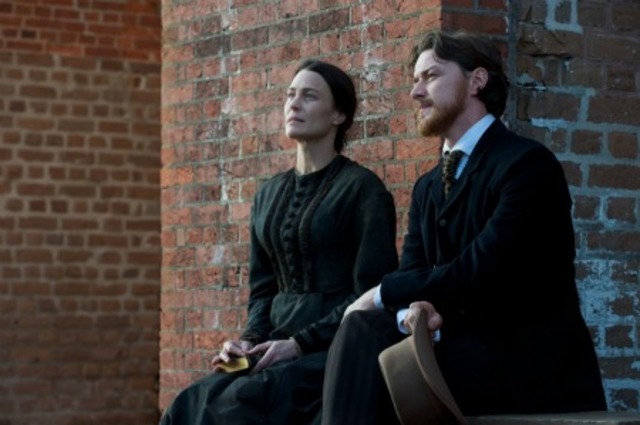
 Failing anything else, this will at least go down as the most star-studded educational film ever made. There’s that at least. Because whatever else is wrong with Robert Redford’s look at the trial that followed the assassination of Abraham Lincoln — and there’s plenty — it seems destined to be screened over the course of a few days at the end of the Civil War unit of high school American History classes for years to come. Where the students will probably find it just as dull as I did.
The film’s role as educational tool is partly by design. It’s the first production from The American Film Company, a production house dedicated to “historically accurate” depictions of important events in America’s past. To that end, they’ve committed themselves to making films in constant consultation with historians, who in turn post essays and lead discussions on the company’s website, which could also presumably be used as educational supplements.
The company’s desire to offer a history lesson isn’t actually the problem. It’s screenwriter James D. Solomon’s heavy-handed, on-the-nose modern-day allegories, coupled with Redford’s tendency to fashion this military courtroom drama with all the scene-chewing melodrama of a 19th century A Few Good Men.
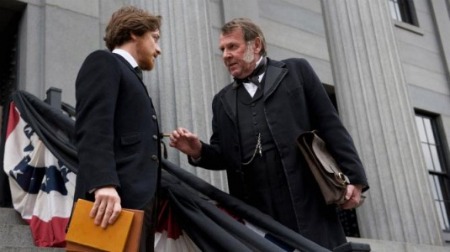 That’s James McAvoy in the Tom Cruise-parallel role of Frederick Aiken, a military lawyer assigned to represent a defendant he doesn’t much care for and doubts the innocence of, before eventually coming around and offering a fiery defense. His client, Mary Surratt (Robin Wright) owned the H Street boarding house (which currently houses the Chinatown Wok ‘n’ Roll restaurant) where the conspirators planned their attack on Lincoln, as well as Vice President Andrew Johnson and Secretary of State William Seward. Her son John was one of the ringleaders, but when he can’t be found in the aftermath of the missing, as the movie tells it, the government went after Mary on the theory that there was no way the meetings could have taken place in her house without her complicity.
The film takes pains to avoid explicitly claiming Surratt’s innocence, which has long been the subject of debate among historians. After her conviction, Aiken seeks a writ of habeas corpus to prevent her execution not because he believes in her innocence, but because he doesn’t know whether she’s guilty or innocent, and doesn’t believe the rushed military tribunal — which began just three weeks after the murder — amounted to the fair and measured trial she was more likely to receive in civilian court.
But Redford needs the audience to root for Surratt, and certainly goes right up to the edge of declaring her innocence without going over. The purpose seems to be to generate sympathy that he doesn’t believe she’d get if he suggested she was guilty, or left the situation more ambiguous. But in assuming that the audience needs to believe in her innocence to be on her side, he undermines one of the central ideas the movie is trying to get across: that a fair and impartial trial and humane treatment of the accused is the right of even those guilty of the most heinous crimes.
Redford guides the film with the heaviest of hands, creating over-dramatic import at every turn. Every other scene seems to take place in a dimmed room with heavenly shafts of soft light pouring through the windows evocatively, an effect so overused that by the end all it evokes is a pronounced eye-roll.
Redford does draw nuanced performances from his more seasoned players: Tom Wilkinson is typically excellent as Maryland Senator Reverdy Johnson, who passes the defense of Surratt to Aiken, ostensibly fearing that a lawyer from a Confederate state wouldn’t stand a chance, but really not wanting anything to do with defending such a reviled character. Kevin Kline brings an air of calculated political evil to Secretary of War Edwin Stanton, pulling the strings of the trial from behind closed doors for maximum vengeance, seeking to give closure to a country he feels needs that far more desperately than justice. But from McAvoy and Wright, the mandate is for overblown courtroom rage and sad-eyed tortured soulfulness respectively, and neither actor dips far below that surface.
The clumsiest manipulations are reserved for the film’s subtext, which is so overt that it barely merits the “sub-” prefix. Everything in the story is cast as a commentary on the filmmakers’ feelings on what they view as reactionary U.S. policy in the post-9/11 landscape. With dialogue peppered with phrases highlighting how frightened the country was after Lincoln’s death, and warning against “abandoning the Constitution” in a time of crisis, the implied parallels are as subtle as Booth’s bullet to Lincoln’s head. One can be firmly in Redford’s choir and still leave the theater with the bad taste of a sermon rammed gracelessly down the throat.
Historical accuracy is a nice goal, but unless every scene is drawn from transcripts of public events, at some point, the same narrative inventions that create drama in every piece of historical fiction have to enter the picture. So where do the filmmakers draw that line? Did Aiken really have a girlfriend (Alexis Bledel) driven away by his obsession with the case? Did he really argue the case by himself, as the movie suggests? (The answer to that one is “no.”) Did he have private meetings with Stanton in which he argued for the sanctity of the Constitution even in times of war, while Stanton argued that some things were more important than the rule of law?
The reality is that The Conspirator is just as much a creative work, bending the facts of history to its own ends, as any other historical narrative. And there’s nothing wrong with that; the invented drama that happens behind closed doors hooks us in to the factual drama of history. But the labored allegory and exaggerated courtroom fireworks Redford uses to bait that hook just serve to make the film feel as stultifying as the driest of high school history lectures.
—
The Conspirator
Directed by Robert Redford
Written by James D. Solomon, from a story by Solomon and Gregory Bernstein
Starring Robin Wright, James McAvoy, Evan Rachel Wood, Tom Wilkinson, Kevin Kline
Running time: 123 minutes
Rated PG-13 for some violent content.
Opens today at a number of local theaters.