Martin Austermuhle
 Photo by mwhatley.
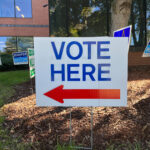
Okay, so we’re about a third of the way through the voting day, and there appears to be a good chance that you haven’t cast your ballot yet. Reports coming in from around the city indicate the turnout has been light — so unless everyone is waiting to vote after work (polls are open until 8 p.m.), we’re looking at another Special Election with sparse participation. We did our best to summarize the context and candidates of the At-Large election in our Voter Guide yesterday, but it might be worth it to lay out the very good reasons that you should head to a polling place today.
- Your Vote Really Counts: You hear this all the time, but it’s probably more true today than ever before. Turnout in special elections has historically ranged from five to 25 percent, and the winner of one of these contests could well be determined by a tiny proportion of votes. Back in 1997, Councilmember David Catania (I-At Large) claimed a win with only 10,818 votes, just over 1,000 more than second-place finisher Arrington Dixon. Only four candidates fought for the seat, and turnout was a meager 7.5 percent. This time around, we’ve got nine candidates on the ballot, six of them Democrats. Votes are splintering along ideological, demographic, geographic and issue-based lines — but no one can accurately predict how. Your vote counts. Really.
- Their Vote Really Counts: As soon as the winner of this Special Election is announced, they’ll jump straight into the unforgiving business of debating and amending Mayor Vince Gray’s 2012 budget, which slashed funding for many social services and hiked taxes on the city’s highest-earners in order to close a $322 million budget gap. The D.C. Council is closely divided between those that want tax increases and those opposed; a single vote could swing the decision either way. Bryan Weaver, Josh Lopez and Alan Page have supported tax hikes in one form or another, while Sekou Biddle, Vincent Orange, Patrick Mara, Dorothy Douglas and Tom Brown have been skeptical. If you feel strongly either way, your vote will count towards making their vote count.
- You Can Send a Strong Message: Let’s be honest — it hasn’t been a particularly good few months in D.C. politics. We’ve had far too many scandals in far too short a time, and it’s easy to see why many residents are becoming more and more cynical about the state of local affairs. Many of the candidates are running on a message of independence, integrity and accountability — all things that seem to be in short supply these days. Weaver has pledged to clean up how campaign finances are raised, while Mara has emphasized stricter controls on how the government spends its money. Page, Lopez, Mara and Weaver have said that they would be full-time councilmembers, and many of the candidates have said that they would support cutting their own pay (currently at $125,000 a year) and instituting term limits. Voting in this election sends a message that things aren’t hunky-dory and that you’re not willing to wait until 2014 and the next mayoral contest until things change.
- It’s the Last Time You’ll Get to Vote for Vincent Orange: Who are we kidding? The man hasn’t met an elected office he wouldn’t run for.
- You Can Vote for a Republican: Republicans have run for and held office in the District for years, but it’s also been a long time since a Republican formally sat on the D.C. Council. This may be the year that changes. Mara has come along at the right time and sounded the right campaign themes to make himself a serious contender for the seat. His emphasis on good government and strong opposition to any tax hikes has won him plaudits from many that are sick of ethical lapses and out-of-control government spending. Better yet, he’s anything but a traditional Republican — he’s certainly not socially conservative, and the man lives in Columbia Heights, not exactly a red hideaway in an overwhelmingly blue city. Ironically, it was Mara himself that knocked the last remaining Republican off of the Council in 2008, when he beat Carol Schwartz in a hotly-contested primary. (Mara then lost the general election to Councilmember Michael Brown, a lifelong Democrat who dumped his party affiliation in order to run for one of the two At-Large seats on the council that are set aside for minority parties.)
- This is What Little Democracy We Get: If this were 1972, you wouldn’t even get to vote for a member of the D.C. Council, much less a mayor. The 1973 Home Rule Act enshrined what little local democracy we have, allowing residents to actually choose who would govern them. Sure, Congress can overrule it whenever it pleases, but we should cherish an opportunity that District residents 40 years ago didn’t even have.
If you don’t know where you vote, check the D.C. Board of Election and Ethics. Polls are open until 8 p.m., though they won’t shut their doors if you’re standing in line. Not registered? No problem — bring a D.C. ID or proof of residence (like a utility bill) and you can register on the spot.