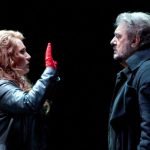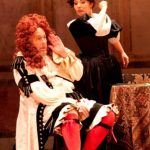
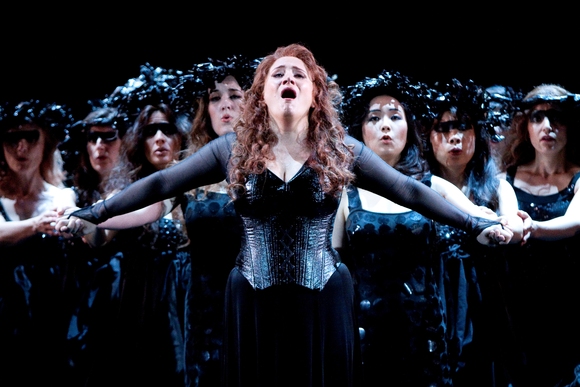
 Patricia Racette (Iphigénie, center) and Chorus of Priestesses in Iphigénie en Tauride, Washington National Opera, 2011 (photo by Scott Suchman)
Washington National Opera has made another significant advance in catching up to the latest trends in opera houses around the world, by staging its first-ever opera by Christoph Willibald Gluck (1714-1787). The new production of Iphigénie en Tauride, which opened on Friday night, turns out to be the best work in an otherwise downsized and somewhat ho-hum season — not only because it is the company’s first Gluck opera and such a beautiful work, but because of a superb cast that proves gripping both musically and dramatically, in a production that is intriguing, stark and far from ordinary.
Gluck premiered Iphigénie en Tauride in Paris in 1779, the culmination of the composer’s heroic attempt to reform opera from a genre that was more about vocal pyrotechnics and stage diversions into something closer to its origins, the revival of the expressive power of ancient Greek tragedy. Continuing from where his previous opera Iphigénie en Aulide had left off, the libretto by Nicolas-François Guillard draws on Euripides’ play Iphigenia in Tauris. The goddess Diana spares Iphigenia from being sacrificed by her father, Agamemnon, at Aulis, to provide winds for the Greek fleet to sail to Troy. Iphigenia is magically transported to Diana’s temple in Tauris, a part of Scythia known today as the Crimean peninsula. Iphigenia’s brother Orestes and his friend Pylades arrive at the temple, sent by Diana herself to bring her sacred images from the temple back to Greece. The Greek visitors are sentenced to be sacrificed at the hands of Iphigenia, as priestess of Diana. Unnerved by visions of who the strangers are, she agrees to let one of them escape and cannot bring herself to kill Orestes, whom she eventually recognizes as her brother. Pylades returns with soldiers to try to free Orestes, when Diana herself descends in a cloud to put all to right.
Without any daringly ornamented arias or anything extraneous that might divert attention from the story’s dramatic continuity, a Gluck opera will succeed only with talented singing actors and compelling direction. There are almost none of the tried-and-true operatic clichés to fall back on, not even a romantic intrigue: the central relationship here is of brother and sister, who do not even recognize one another until the end. In the title role, soprano Patricia Racette was riveting, the searing strength of her voice underscoring the still intensity of her stage presence. This was certainly what one expected of Racette, after such satisfying turns here as Jenůfa in 2007 and Ellen Orford in 2009, but her bold and electrifying performance far exceeded my hopes. After some tentative notes at the top of her range in the first hour or so, Racette hit her stride, singing with lyrical abandon in the Act IV aria “Je t’implore et je tremble.”
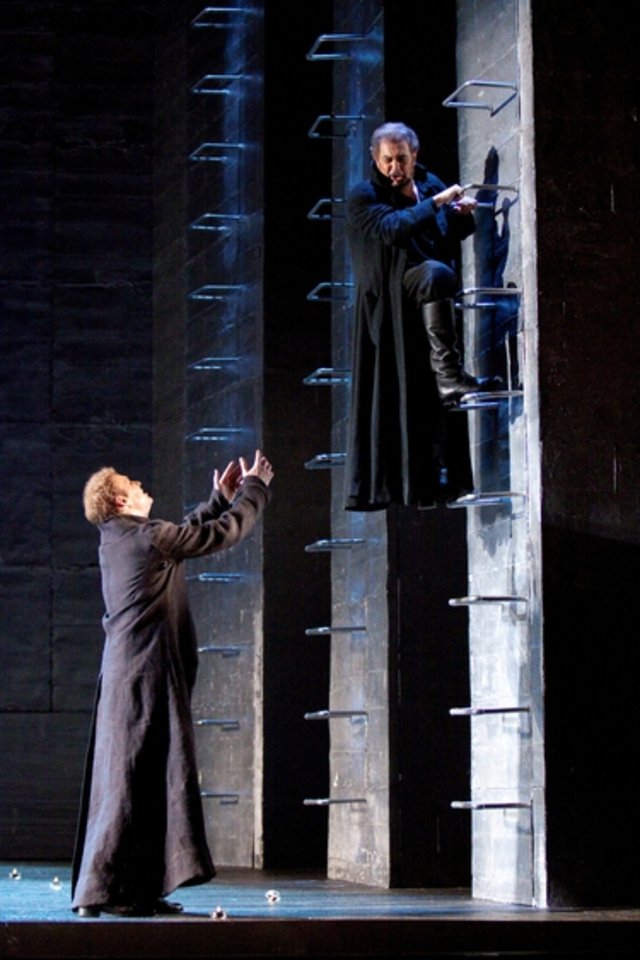
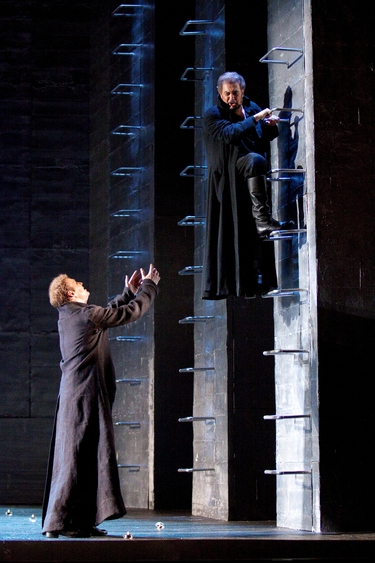 Shawn Mathey (left) and Plácido Domingo (right) in Iphigénie en Tauride, Washington National Opera, 2011 (photo by Scott Suchman)
Matching her in every way except full-bodied strength is the swan song of the company’s departing artistic director, Plácido Domingo, who moved around the stage with dignity, energy and flexibility that belied the fact that he just turned 70. Even more surprising is that this remarkable singer continues to explore new roles, often moving downward into the baritone range (or transposing tenor roles downward) as his higher range becomes less reliable. Oreste was originally written for a high baritone, even partially notated in C clef, and then sung by a tenor in the Vienna revision, so it sits comfortably for Domingo’s current vocal disposition: his sound blossomed particularly well in the second half. He has recently brought this remarkable opera to the Metropolitan Opera in New York, and it is in many ways his parting gift to the Washington audience.
Domingo was ably partnered by the promising young tenor Shawn Mathey as Pylade, with a heroic ping in his voice that offers many good qualities to be built on as he grows into it. As the vengeful Scythian king Thoas, Italian baritone Simone Alberghini had all of the vocal puissance we heard in his Figaro in the 2009 Barber of Seville, rounding out a top-notch quartet of principals. Singers from the Domingo-Cafritz Young Artist program all made strong contributions in the supporting cast, especially mezzo-soprano Sarah Mesko (Second Priestess) and the full-powered soprano Jennifer Lynn Waters (Diana), both impressive also in the Young Artists production of Madama Butterfly earlier this year. Waters’s vocal presence was all the more striking in that this Diana appeared not as a dea ex machina but sang from the second balcony. The chorus was generally fine, and the women who served as the chorus of priestesses, often physically and vocally in mirror movement with Iphigénie (one of Gluck’s most remarkable achievements in the opera, the operatic equivalent of the traditional Greek chorus), sounded particularly excellent: like a well-balanced ensemble rather than, as many opera choruses, a collection of individual, loud voices.
Gluck’s operas often work well with a streamlined, minimalist production that recalls the starkness of Greek tragedy, as in Alceste at Santa Fe Opera and Robert Wilson’s Orphée et Eurydice. This production was imported from Spain’s Ópera de Oviedo, and the austere, slow-moving stage direction by Emilio Sagi, metallic and generically modern sets by Luis Antonio Suarez, and neo-futuristic costumes by Pepa Ojanguren create an appropriately abstract and timeless setting. The Furies who haunt Oreste, a menacing but ultimately faceless presence who appear throughout the opera, are evoked in subtle and effective ways with light and shadow. Best of all, there was little that distracted from the action, with the possible exception of the Flash Gordon-esque ballet of the Scythians in Act I. The choreography by solo dancer Diniz Sanchez is appropriately barbaric, with men and women moving en pointe and one on stilts, but it undoes Gluck’s hard-fought effort to make such ballet scenes an integral part of the story. The orchestra gave a generally unified and glowing performance of this lovely score, putting the guest conductor, William Lacey (who has not much impressed me in previous outings), in the best possible light.
This production of Gluck’s Iphigénie en Tauride continues for six more performances, beginning this evening (May 9, 12, 15, 17, 20, 25, and 28), in the Kennedy Center Opera House.