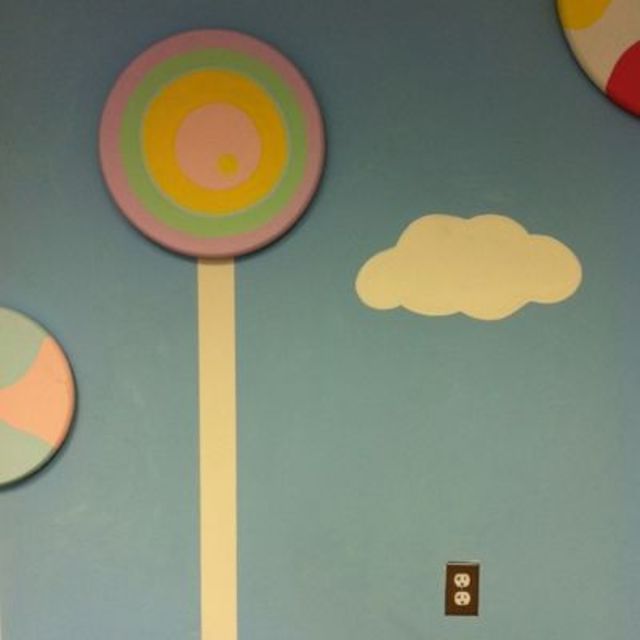
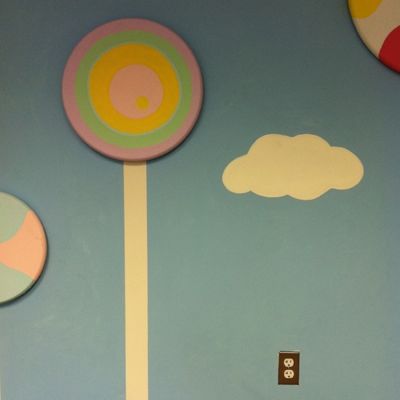
 Detail from Cory Obendorfer’s Lollipop Garden. Photo by Pat Padua.
I always approach group shows and art fairs with some trepidation. But this year’s G40 Art Summit, curated by Art Whino at the inauspiciously named but thank-you-corporate-benefactor vitaminwater® uncapped LIVE, is so chock full of art that even the most jaded gallery goer is sure to find something they like. With hundreds of artists and thousands of art works, G40 has plenty to say. Some of it you’ve heard before. But much of it is said in enchanting and provocative ways — not to mention subversive: consumerism is on display wherever you go, but, despite those corporate sponsors, not always with a ringing endorsement.
Commerce and art meet uneasily in a second-floor gallery of D.I.Y. Vinyl, variations on collectible toys like the kidrobot Munny. The room’s walls are painted with utility lines, railroad cars and other urban signifiers, ironic in that the space sits on an increasingly gentrified stretch of 14th Street NW, mostly shorn of the grit that these walls romanticize. (Anybody remember Soul Parking across the street?) Among these ambitiously customized toys is an intriguing anomaly that stands out from the grotesque Munnies. John “Spanky” Stokes’ series of “Borracho de Los Muertos” resins slyly riffs on Day of the Dead imagery. His skeletal “drunks” seem bloated on mass consumption — not just of corn squeezins but of entire colonies of miniature collectibles. The Viva Mexico sombreros add a scathing critique of cultural tourism.
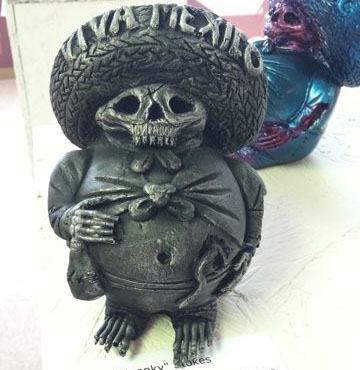 John “Spanky” Stokes, Borracho de los Muertos
There are plenty of references to cuddly commercial mascots in G40, often re-contextualized like “Angry Smurfs.” But there’s more to social satire than just ‘tude. Cory Oberndorfer’s Lollipop Garden installation is an enchanting, and subtly unnerving, surprise. The artist doesn’t need to make pop culture references to convey his ironic Eden: the walls of the space are simply decorated with sculptural lollipops that emerge from the pastel walls like candy-colored bas-reliefs. What makes the space surreal, and a little subversive are the electrical sockets — a nod to practicality in this childlike reverie, but also an acknowledgement of how much of our 21st century playtime requires alternating current. I’m sure visitors stop here to charge their iPhones, a spectacle that only proves the artist’s vision.
Ben Tolman‘s wheat paste grotesques are well within the street art tradition that predominates here. But he also breaks away from tradition by effectively closing the fourth wall. His blobular ink drawings are pasted on rusty metal plate canvasses that approximate the texture of weathered utility poles. These are more compelling backdrops than the “native habitat” where I recently caught one of his wheatpastes: the shiny backside of a Foggy Bottom stop sign. The framing of these mini-canvases isolates the figures, and encourages the artist’s keen compositional sense: with plenty of negative space, Tolman’s droopy-eyed beasts emerge from the frame’s edges like fun-house mirror Gyllenhaals.
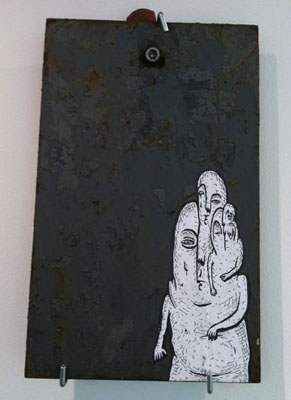 A Ben Tolman wheatpaste.
Frequent DCist Photo of the Day contributor Joshua Yospyn takes his signature cropping to a new and fresh extreme with a series of Fuji instant film mosaics. The cubist portrait V62 recalls David Hockney’s polaroid mosaic of Talking Heads, but the fragments of Yospyn’s model are less systematic and haphazardly aligned. Systematic and grid-justified but even more disorienting is its companion piece Nipples, which depicts a single nipple in a handful of hues, arrayed as one huge Braille distress signal. Which is what the isolated nipple seems to convey, shorn from its other half. The tonal variations bring to mind the racial context of Byron Kim’s Synecdoche. But while Kim’s piece revels in the varieties of skin color experience, Yospyn’s mosaics suggest that the fragments by which we know one another only tell us so much about the soul inside. Can we really know anybody by their nipples?
As in any group show, unexpected resonances occur between artists. A distant cousin to Yospyn’s anatomical pointillism is Kensington artist Elena Patino’s site specific installation “Radial Population II,” which consists of hundreds of colored pins stuck to a white-walled corner. The piece is inviting, fragile and slightly dangerous. Patino is one of 18 installation artists in the microWave project, one of numerous smaller group shows under the G40 umbrella. Another mini-show is devoted to the bare-knuckle boxing champion whose name and image appear on the merch of another of G40’s corporate sponsors, John L. Sullivan Irish Whisky. While arguably not as good for you as vitaminwater®, whiskey is clearly a more inspiring muse — and as commercial mascots go, you’d be hard pressed to find one with more danged gumption. The mustachioed Bostonian is interpreted in manners playful and pensive, and the juxtapositions can be startling, with Brooke Olivares’ muddy impressionistic oil hung right next to Chris Bishop’s streamlined retro acrylic.
A number of artists turn up in different contexts throughout the show. Skateboard culture may not seem a promising medium, but in a hallway lined with artist interpreted skate decks, Oberndorfer scores again with an array of three pastel polka-dotted decks. Sylvia Ortiz’ anxious anatomies (her paintings are on on view in a gallery nearby) are given disturbing new context in a medium built for punishment. Eugene Good’s weathered tiki-decks are perhaps more unridable than his neighbors’ and are a telling connection between primitive ritual and modern leisure.
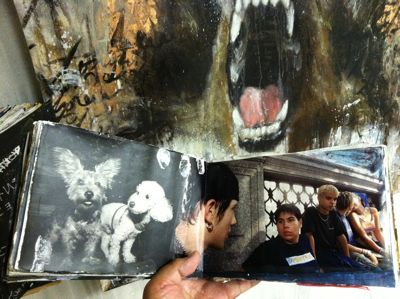 One of James Walker’s art books.
James Walker‘s skate decks are also weathered, but his assemblages are but a slice of what’s in store in the full gallery of his works: paintings, shadowboxes and photographs, culminating in a fascinating series of artists books and scrapbooks, fragile and densely textured with photographs, sketches, painting, personal ephemera, and in one book, a carefully scotch-taped cockroach. The natural state of things is decay, Walker suggests. A recurring, snarling dog seems like an anti-social avatar at first. But the animal’s appearance in the artist books, and in a diptych in the Sullivan room, reveal it to be an homage to the courage of a faithful companion, an unexpectedly touching connection with nature in the middle of a sprawling urban artscape.
G40 2011 is on view at vitaminwater® uncapped LIVE, 2213-2217 14th Street NW (the corner of 14th and Florida Avenue NW) until June 17th, 2011. The venue is open Tuesday-Thursday: 5 -10 p.m.; Friday-Saturday: 12 p.m. – 11 p.m.; Sunday: 12 p.m. – 6 p.m.; Monday: closed. On Tuesday, May 31st, join Joshua Yospyn and fellow photographers Dakota Fine, Kyle Gustafson, Josh Sisk and Chris Chen for a photo panel from 6-8 p.m.