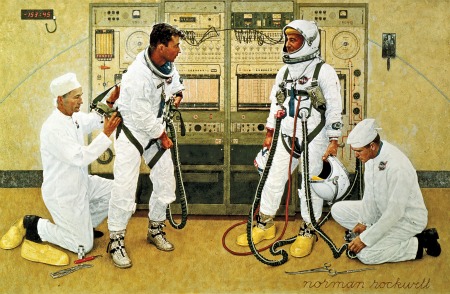
 “Grissom and Young,” Norman Rockwell, 1965, Oil on canvas. Courtesy Smithsonian National Air and Space Museum. Licensed by Norman Rockwell Licensing, Niles, IL. Copyright: Smithsonian Institution
As someone whose two biggest passions are space exploration and art, I actually have trouble appreciating the point where they meet. Space art so often comes off as passed-over sci-fi novel covers, making our real-life spaceships look like weak representations from our unbounded-by-the-laws-of-physics imaginations. And on the flip side, so much that we’ve discovered in the universe is actually beyond our wildest imaginations — why would we think a mere human could give it life by restricting it to paper and ink?
So even with names like Alexander Calder, Andy Warhol, Norman Rockwell and Nam June Paik, I worried that I would be disappointed by NASA | ART: 50 Years of Exploration, opening this Saturday at the Smithsonian’s National Air and Space Museum. Thankfully, while there are still a couple that cross the cheese-barrier (think: Starship Enterprise “encounters” the Space Shuttle, sigh), the exhibition as a whole is, I admit it, pretty damn spectacular.
In 1962, then-NASA Administrator James E. Webb began to invite artists to have special access to the astronauts, engineers and spacecraft during the tail-end of the Mercury program, just as Gemini was getting off the ground. NASA | ART includes over 70 artworks from the nearly 50-year span that has so far gathered 3,000 pieces in both NASA’s and the Air and Space Museum’s collections. As co-curator Burt Ulrich notes, the exhibit is meant to “see how far we’ve come as a nation, and as human beings.”
Some of the most moving works are almost off-the-cuff sketches, trying to capture crucial moments before they pass. Paul Calle, one of the first artists commissioned by NASA, made some ink drawings while he watched Michael Collins suit up for the launch of Apollo 11 – apparently Collins was fascinated and, in the middle of preparing for the first moon landing, chatted with the artist and asked to flip through his sketches. Calle’s casual representation created during one of the most tense moments in American history will give you chills.
Norman Rockwell brings the requisite Americana-stylings to the exhibit, with two paintings – particularly Grissom and Young, getting air hoses attached to them by clean room technicians – that turn the dawn of the space age into his patented, but this time quite surreal, “just another mid-century day getting suited up for launch.” However, some of the best Americana of the space program is so subtle, you might have to be told it is indeed about the space program. George Weymouth and James Dean (the founding director of the NASA Art Program and co-curator of this exhibit) paint the calming beaches on the Merritt Island Wildlife Preserve, with tiny launch towers on the horizon, reminding us of the beauty of this world while we strive to find it elsewhere. Some humor is supplied by Chrystal Jackson’s Moon Hut, with sketches of the space tourism industry that popped up in Cocoa Beach in the 1960s, complete with a hamburger and its menu description with “satellites of onions.” These cultural moments move towards the iconic with Annie Leibovitz’s portrait of Eileen Collins, in her orange suit preparing to launch as the first female space shuttle commander in 1999.
 “Fluid Dynamics,” Tina York, 1995, mixed media. Courtesy NASA Art Program. Copyright: Smithsonian Institution
A few successful works veer away from the amazing visuals of space exploration and focus on the power of these new spacecraft. If you’ve ever felt the chest-shaking, ear-pounding reverberations from a launch, you’ll have a special appreciation for Theodore Hancock’s The Sounds of Engines, created in Huntsville, Alabama while experiencing the shockwaves as workers tested the Saturn V engines. Tina York uses mixed media for a beautifully graphic display of fluid dynamics (i.e. how we figured out we can make things fly), while Barbara Ernst Prey uses brilliantly toned watercolors to create movement for NASA’s X-43, the fastest aircraft in the world. Prey noted at the media preview that she “didn’t know much about NASA or the universe” until she was commissioned for the portrait, and indeed, had to “research the color of the sky” at the altitude the X-43 flies for a true-to-life background. That discovery of the impressive colors of nature and movement of machines comes alive in these works.
The exhibit is successful by generally skipping the works that force romanticism into space exploration, thus allowing the viewer to impose on them the inexplicable and powerful story of how humans managed to leave the confines of this planet. You’ll leave amazed that we were capable of doing it all, and disappointed that the exhibit, like so much of the space program, ends.
NASA | ART: 50 Years of Exploration opens this Saturday at the National Air & Space Museum on the National Mall, on the second floor. The museum is open daily, 10 a.m. to 5:30 p.m.