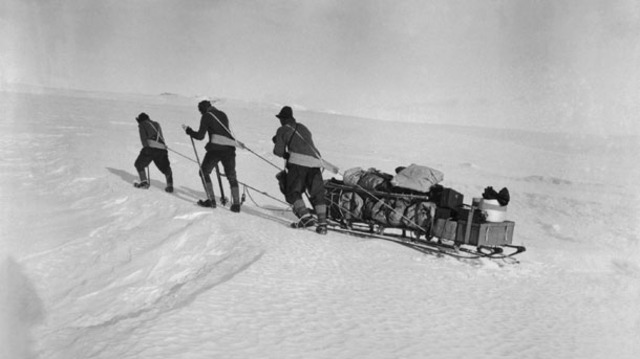
 Proceed as Though This Had Not Happened; Robert F. Scott and team in Antarctica haul a sledge across the ice. Photograph copyright Bettman/CORBIS. Photo courtesy National Geographic.
>> National Geographic will be hosting two traveling exhibitions this summer. The perfect escape from summer swelter, Race to the End of the Earth looks back at the competition between Norwegian explorer Roald Amundsen and British Royal Navy Captain Robert Falcon Scott to be the first to reach the South Pole in 1911. On June 13, join curator Dr. Ross MacPhee as he narrates the dramatic story in Proceed as Though This Had Not Happened, 7:30 p.m., $18. Do you have what it takes to explore a desolate landscape? Head back to the museum on June 26 for Challenge Antarctica: A Family Workshop and test your decision-making skills against those of the expedition. 1 p.m., Free. Additionally, The Etruscans: An Ancient Italian Civilization opens June 10 with more than 400 exhibit artifacts range from everyday domestic implements, tools and weaponry to jewelry and expertly executed sculptures. Visitors can explore spiritual beliefs, trade, and daily life in Etruria in the sixth century B.C. Exhibitions are included in Museum admission.
>> Naval District Washington will host the Battle of Midway commemoration on the 69th anniversary of the historic battle. During the ceremony, guest speaker Adm. Gary Roughead, USN, Chief of Naval Operations, will recognize and honor several veterans who survived the battle. June 3 from 9 a.m. to 12 p.m. Free.
>> Become A Pilot at The National Air and Space Museum’s Udvar-Hazy Center’s 7th annual Family Day and Aviation Display on June 18. Talk to pilots, see 50 visiting vintage, recreational, military and homebuilt aircraft, catch a performance by the U.S. Naval drill team and enjoy a musical performance by U.S. Navy band, The Commodores. Free, but parking is $15. Delay the kids’ summer brain drain, or even your own, at the Museum’s full schedule of Story Time, Ask an Expert and book signing events throughout the month.
>> On June 4-5, The Textile Museum hosts CELEBRATION OF TEXTILES – What’s Old is New: A Salute to Recycling and Green Design, an annual two-day festival, complete with hands-on textile activities, sheep shearing, embroidery, weaving, and lace-making demos. On June 9, start the summer off right with an Urban Picnic featuring music, lawn games, and drinks, co-hosted by The Pinkline Project. 6 to 9 p.m. Tickets are $10.
>> Discover the beauty and meaning in North African mosaic design at The Art of the African Mosaic, a workshop led by mosaic artist Valerie Theberge at the National Museum of African Art on June 4. Free, but RSVP is required; email or call 202-633-4633.
>> Learn more about the Government’s effect on the American diet in What’s Cooking, Uncle Sam?, an exhibit coming June 10 to the National Archives‘ Lawrence F. O’Brien Gallery. Free.
>> The American Art Museum hosts George Ault’s Disquieting World, a discussion by historian and writer Stephen May on the painter’s haunting, memorable interpretation of mid-20th century America during an era of crisis. The talk is presented in conjunction with the museum’s exhibit, To Make a World: George Ault and 1940s America, which features approximately 50 paintings, drawings and photographs by Ault and his contemporaries, including Edward Hopper and Andrew Wyeth. June 2 at 7 p.m. Free. Book signing to follow.
>> Family Matters: Portraits from the Qing Court comprises sixteen paintings of emperors, empresses, princes and princesses, representing three generations of the Qing dynasty imperial family from the early to mid-eighteenth century. Opening at the Arthur M. Sackler Gallery on June 11, the exhibit is almost evenly divided between images of men and women, and the portraits — some nearly life-size — show the royal family members dressed in both elaborate formal robes or casual leisure attire.
>> Paper Engineering: Fold, Pull, Pop & Turn, an exhibition celebrating the history of the pop-up book, from the year 1570 through present day, opens at the National Museum of American History on June 14. Although today pop-up books are often found in the children’s book section, the earliest movable books were tools to educate and document information, such as a calendar, the moon’s movements or even the inner workings of the human heart.
>> Race: Are We So Different? explores the concept of race from scientific, historical and cultural perspectives in a new exhibit opening June 18 at the Smithsonian National Museum of Natural History. The exhibition offers a powerful look at race and racism, and challenges visitors to ask questions, think critically and talk about the issue and their own experiences.
>> Beginning June 23, contemplate your own spatial awareness as you view Fragments in Time and Space, a multi-media exhibition culled from the Hirshorn Museum’s collection that demonstrates the diverse ways in which artists have conceptualized, employed and manipulated time and space since the beginnings of Modernism. Free.