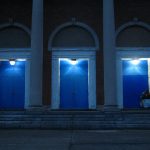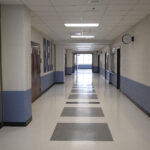
 How to Unlock Education, Photograph by Joshua, Washington Metropolitan High School.
While textbooks may be the primary instruments used in D.C. classrooms, many school libraries offer resources for students to expand their knowledge beyond core curriculum, explore topics of individual interest and provide exposure to books and computers that may not be available at home. Many students for whom school libraries are accessible and well-stocked may take them for granted, not realizing that for many of their classmates within the city, like those at Washington Metropolitan High School, such resources are simply not available. But some of the students actually care and are demanding more from their school system.
D.C. Met, as it’s known to its students, opened in an old middle school building located in Ledroit Park on the Howard University campus in the fall of 2010. With no pre-existing library or funds to establish one, students have not had access to the resources available to students in other schools, including books, study aids, computers or, of course, a librarian. Students like Joshua and his peers understand the role school libraries fill in a well-rounded education, and are determined to influence change and make the library a reality by advocating for policy changes from those in power, believing that DCPS should guarantee that no school be without a functioning library due to lack of funds. They are working very hard to draw attention to the needs of their school and are accomplishing this through photography.
“This is a broken doorknob sitting on a table. It needs to be fixed just like the education system,” explains Joshua, a rising senior at Washington Metropolitan High School, who names Gordon Parks, Marion Palfi, and previous Critical Exposure students as photographic influences.
“The doorknob is a symbolic figure of how the library is not in use during the school year. The library and the doorknob are one in the same: dysfunctional. But we can do something about it if we have help from those in power,” he says. “We need help to build up our library so that we can have more access to knowledge. Since we didn’t have a library this year, students are completely missing out on access to books that everyone else has.”
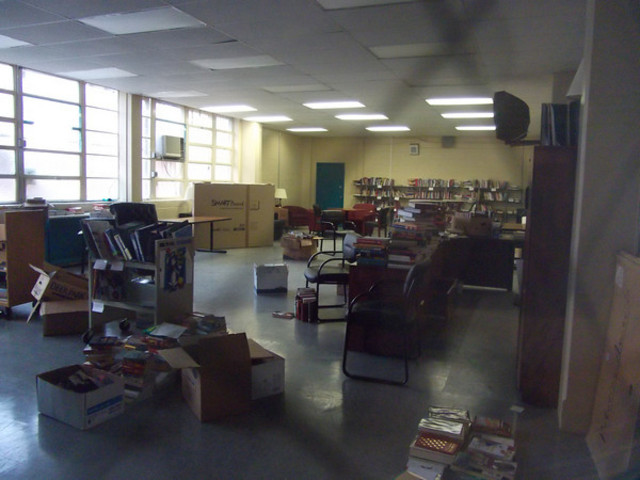
Joshua and students like him have found their voice through Critical Exposure, a nonprofit program that teaches youth to use the power of photography and their own voices to become effective advocates for school reform and social change. Students have the opportunity to speak out about the issues that affect them personally through photographs that document and spotlight their concerns, such as the empty room where unorganized boxes of books are stored on the dusty floor. Across the city, the student-driven campaigns target issues like the quality of school lunch programs, access to arts and after-school programs and the opening of Roosevelt High School’s front door, which has been closed for years, limiting students to a back alley entrance.
 School library, Photograph by Joshua, Washington Metropolitan High School.
Critical Exposure partners with the community through advocacy groups, youth organizations and public schools to teach workshops on documentary photography, social advocacy and support campaigns for change. Since its foundation in 2004, more than 1,000 students in D.C., Baltimore, Arkansas, New Orleans, Philadelphia, Austin and Albuquerque have developed skills as documentary photographers, resulting in $400
million in new funding for underfunded schools and facilities in D.C., Maryland and Pennsylvania.
Using photography, the students at D.C. Met invited members of the D.C. Public Schools’ Office of Youth Engagement and the Shaw Public Library to a “Library Action Meeting,” where they presented photos comparing their books to that of a real public library. The D.C. Public Library responded with a commitment to establish a public library outpost with several hundred books on long-term loan to the school, as well as provide a lunchtime book club for students. Community members have also pledged to help students meet with D.C. Councilmembers, ANC members and other literacy advocates to continue securing the resources they need to have a stocked and staffed library.
 Joshua, Photograph by Diamond, a 9th-grader at Washington Metropolitan High School.
They also like to have fun. The students, who participate in the program through after-school programs, electives and workshops, show off their hard work in a photography show at the end of the year. BOTH SIDES OF THE LENS: The Faces and Stories of D.C. Youth opens tomorrow between 6 to 8 p.m. at PEPCO Edison Place Gallery, with more than 80 photographs from over 50 students representing at least a dozen schools within the District, as well as two in Arkansas. The opening reception is open to the public, with a $35 suggested donation.
Preview all of the photographs online, then stop by and meet these amazing students, including Joshua, who hopes to go to college and eventually medical school. If you can’t make it to the opening, consider making a tax-deductible donation to support Critical Exposure in their efforts to initiate change through these student-driven photojournalism campaigns.
[Ed. note: we’ve omitted the last names of participating students, per request.]