With the recent classic cocktail renaissance, there has also been a renewed interest in punch. But this is not the sherbet punch of high school proms or children’s birthday parties. Instead, it takes the form of a potent potable, combining a minimum of five ingredients, none of which are plopped out of a bundt cake-shaped mold (unless you count ice).
In early 2009, we were treated to a small experiment called Punch Club, an event held at the Warehouse Theater as the owners of Room 11 were building out their space in Columbia Heights. Every week, bartender Dan Searing would serve a variety of classic punches, developing quite a knack for it.
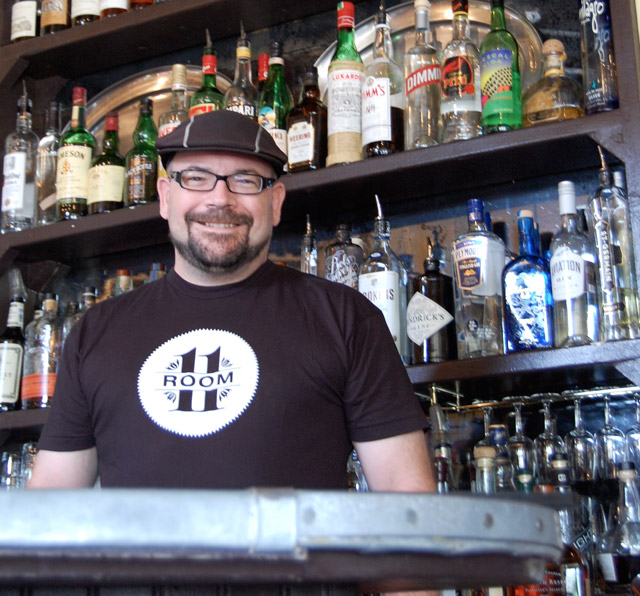
Fast forward to 2011, and Searing has been knocking out cocktails and punches at Room 11 for about a year and a half. And now the former journalist has released a new book, The Punch Bowl: 75 Recipes Spanning Four Centuries of Wanton Revelry. I sat down to talk with Searing about his book.
How did you get started on writing the book?
The book was initiated by something I didn’t know existed before, a book packaging company. So basically, someone who has ideas for books, and then puts together the various components of the creative process. They hired a photographer, and made the connection with the person who had all the beautiful punch bowls featured in the book. Derek Brown [of the Columbia Room] had been approached about the project, but he was unable to do it because of some scheduling issues and other concerns. He knew I was very dedicated to punch making, and I leaped at the chance.
How did you go about researching the book? To me it doesn’t seem like a very straightforward process.
A lot of the vintage recipes were already collected from old cocktail manuals. A lot of that stuff, as many people know, is in the public domain. In many cases, the publishers or authors of the original books are no longer with us and trying to maintain their intellectual property rights. Mud Puddle has reissued a lot of vintage cocktail manuals in facsimile form. There’s a lot of really great information out there, but it’s all not necessarily easy for even professionals, let alone for the home bartender, to find.
The most important part of the work that I did on the book was assembling the contemporary punch recipes, of which there are 25, and editing and writing introductions to them. It turned out to be a more interesting process than I expected. Because until you’re looking at 25 recipes written by 25 different people, you don’t realize how differently everyone approaches the idea of recipe writing. So we had to make them all consistent in their approach. Some were two parts this, one part that. Others were use a bottle of this and half a bottle of that. Others were in ounces, and some were in milliliters. I now have a great respect for people who have to assemble recipes for food or drink.
I was surprised to read in the book that punch originated in India. How similar are the ingredients in Indian punches to what we know today?
I think the original Indian punches aren’t too far out of our reach. Lemons, sugar or some kind of sweetener. The sweetener was probably less processed then, so you could use things like Demerara sugar or even brown sugar to get closer to the original flavor.
At its heart, punch is really simple. It contains five ingredients. The word for punch comes from a word in Hindu dialect that means five. Of course, there’s five fingers on the hand, so that’s a concept that you can imagine people having an easy time remembering and transmitting and spread throughout the world by sailors.
The biggest barrier to being able to taste what those punches would have been like, is getting arrack, which is a sugarcane-based spirit that was a precursor to rum. The one that is available is Batavia Arrack van Oosten, which is made in Indonesia. I think it was a pretty rustic beverage back at that time, and it still has a great deal of aroma and power in terms of being high-proof and intense flavor, like the more pungent rums you associate with Jamaica. It’s certainly not hard to make something close to what was being drunk back then, if you have the stomach for it; because it was a pretty rough and ready beverage.
When you were doing research for the book was there anything that surprised you?
I was surprised by the breadth and depth of the imagination that went in to making these modern punches. As we discussed, punch in its origins was fairly simple. Some of the contributors in the book used unexpected ingredients in unexpected ways. There’s a cocktail from Jon Harris at The Gibson that uses India Pale Ale, which is kind of a fun reference to the origins of punch. But it’s also really strong, so it requires a deft hand to make it work. There’s also a recipe from Gina Chersevani that uses a beet reduction, which has a great impact in terms of color and flavor. It represents an important branch of contemporary mixology that’s culinary in inspiration.
Is there anything that you wish you could have included that didn’t make it in?
The deadline was fairly tight, and I do wish I had more time to reach out to the bartending community. Since I had to turn in my writing I’ve met so many people whose punch recipes I would have loved to include in the book. I’m hopeful one day I’ll get to do a sequel to gather together some more of the fantastic punch recipes I’ve come across since the book was written.
What was the first punch you ever made?
The first punch I made as a professional was when I was a fill-in server at Hummingbird to Mars, and I worked a couple of the evenings. That’s where I became fascinated by the idea of punch in the historic context that’s well known to us in the imbibing community. So I made what I now is Billy Dawson’s Punch, which is in David Wondrich’s book on punch, which I highly recommend. It’s very complementary to this book because it approaches punch in a different way. But it’s a wonderful recipe. It’s a beautiful piece of poetry or prose about drink. He says, “No man can make a great punch unless he’s convinced that he’s making the absolute best punch. And this is I make the best punch,” and lists the ingredients. And one of the things about it that fascinated me was that it involved beer as a finishing touch, a porter or a stout, which I thought was very interesting and unexpected. And it does add a difficult to identify, but really useful flavor component to the punch.
A few weeks ago, we wrote about a 48-ounce martini, and some in the bartending/boozing community criticized it. Is there a difference between a 48-ounce martini and a punch? Or is it just semantics?
I’m not really sure. I think it depends on what’s in the cocktail. I think myself, like many of my fellow bartenders and consumers, are happy that the days of the bird bath-sized martini are gone. A 48-ounce cocktail is great for publicity, but maybe not so great for enjoyment. I suppose you could say a bowl of punch is a 48-ounce or greater cocktail that you enjoy with a dozen of your friends. If you’re going to share a cocktail like that, I’m for it. But if it’s meant to be consumed by just a person or two, then I don’t think that’s a very good idea. And that should be left to the people who are still at a stage in their experience where they’re enjoying beverages as stunts. I think that the great thing about punch is that it’s a cocktail to be shared. It can be made in advance, which is sometimes useful for the host. Everyone’s drinking it together. You’re all enjoying it together.
As part of The Hour’s second anniversary on June 21, Searing will be signing copies of his book from 4-6 p.m. and serving a free, non-alcoholic punch. You can continue with more inebriated revelry from 6:30-8:30 p.m. during their private party. Tickets for the private party are $25, and can be bought in person or over the phone. You can also sample some of Searing’s Jamaican punch at Marx Cafe‘s June 24 Sound Clash reggae night.