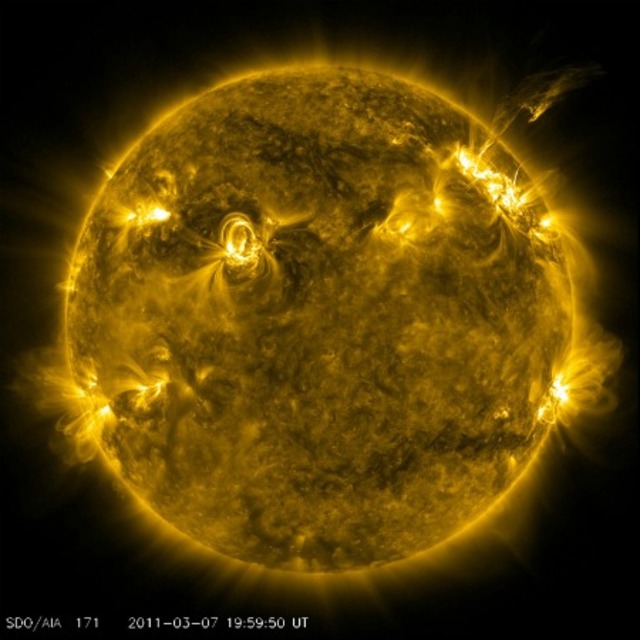
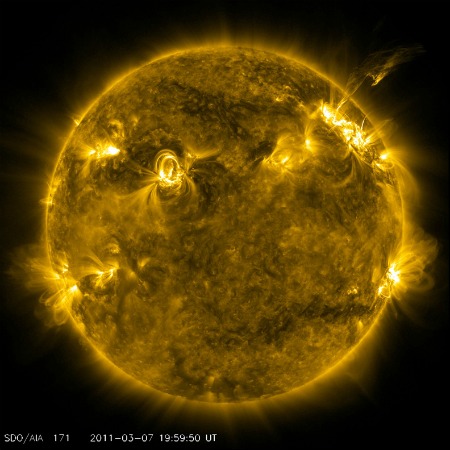
 Image of the sun in extreme ultraviolet light, taken by NASA’s Solar Dynamic Observatory in March 2011. Credit: NASA/SDO.
We’ve already experienced ten days over 90 degrees in Washington, D.C. this year, so it’s hard to believe summer hasn’t even started yet. Next Tuesday marks the summer solstice for the northern hemisphere, as Earth reaches the point in its orbit where its tilt edges us closest to the sun.
Take a moment to think about the sun while it lingers in the sky during the longest day of the year. We’re learning new things about our closest star all the time, and there’s been a lot of talk lately as the sun moves towards solar maximum. This truly enormous coronal mass ejection on June 7 freaked some folks out, but despite its huge particle cloud, the flare wasn’t even as powerful as the class X2 flare that occurred on Valentine’s Day this year. (Solar flares are classified in order from least to most powerful: A, B, C, M, and X. Last week’s flare was an M2.)
Despite all this action, scientists are now saying the sun may be going through an unusually slow period. Every 11 years, approximately, the sun goes through a minimum and a maximum, calculated by the amount of magnetic activity, which is the source of solar activity like sunspots, prominences and these solar flares. The most recent solar minimum was calculated to be the deepest (or least active) minimum in the last century. Even though the sun is working up towards maximum, that general slow-down seems to be continuing — indeed, scientists are batting around the words “hiatus” and “hibernation.” Space.com has the news from a briefing last Tuesday by National Solar Observatory’s Solar Synoptic Network at a meeting of solar physicists in New Mexico.
Currently, the sun is in the midst of the period designated as Cycle 24 and is ramping up toward the cycle’s period of maximum activity. However, the recent findings indicate that the activity in the next 11-year solar cycle, Cycle 25, could be greatly reduced. In fact, some scientists are questioning whether this drop in activity could lead to a second Maunder Minimum, which was a 70-year period from 1645 to 1715 when the sun showed virtually no sunspots.
What does this mean, if anything, for us? Frank Hill, associate director of the Solar Synoptic Network summed it up: “If we are right, this could be the last solar maximum we’ll see for a few decades. That would affect everything from space exploration to Earth’s climate.”
Space Notes:
>> Aviation nuts should head over to the National Air & Space Museum’s Udvar-Hazy Center near Dulles tomorrow for their annual Become A Pilot Day. Talk to pilots about their careers and see 50 vintage, recreational, military and home-built aircraft that will fly in and be displayed outdoors, then head inside the museum for tons of hands-on activities. Don’t forget to say goodbye to Enterprise before it heads up to those ungrateful New Yorkers and is replaced by Discovery. Event is free; parking is $15.
>> RSVP by close of business today to awisdc [at] gmail [dot] com to hear a lecture on the power of space telescopes by NASA astrophysicist Dr. Amber Straughn. “The Hubble and James Webb Telescopes: Portals into the Universe” will, according to the release, “leave you wide-eyed and yearning for more beautiful photographs of our seemingly endless universe.” Count me in. Sponsored by the Association of Women in Science. June 22, 6:30 p.m., National Museum of Natural History. RSVP required for after-hours admittance.
>> Tickets are all gone for the annual John H. Glenn lecture at Air & Space’s Mall location — the extremely popular event featured the crew of Apollo 13 last year, and the crew of Apollo 11, even the elusive Neil Armstrong, on the 40th anniversary of the moon landing in 2009. This year, namesake John Glenn and fellow astronaut Scott Carpenter will talk about their days in the Mercury program. Watch the live webcast on June 23 at 8 p.m.