One of the most coveted tickets of the year for space fans to get their hands on is to the annual John H. Glenn Lecture at the Smithsonian National Air & Space Museum. First delivered in 2004, it has featured some of the biggest Astronaut Heroes of our time — I first attended in 2009, when Neil Armstrong, Buzz Aldrin and Michael Collins, along with NASA’s first Flight Director, Chris Kraft, spoke about the first moon landing with Apollo 11. Last year, the series featured the crew of Apollo 13 and their harrowing but brilliantly inspiring tale of human ingenuity.
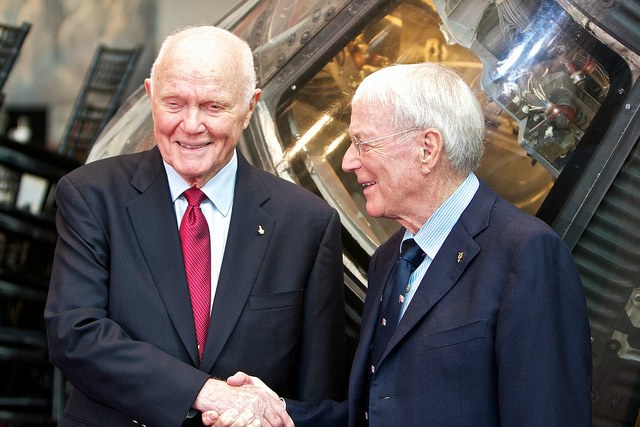
This year, the series took a step back to the very beginning with the lecture’s namesake, Senator John Glenn and his fellow Mercury astronaut Commander Scott Carpenter, who spoke to the packed IMAX theater about the nascent steps of the American space program. The event had a bittersweet tone: as exciting it was to sit and hear tales from Glenn and Carpenter, it’s impossible not to remember that they were called the “Mercury 7” — and at ages 89 and 86, respectively, these are the only two of the seven still alive to relay those tales firsthand.
The two started the event with a lengthy, adorable back-and-forth jabbing session. Carpenter started by noting that as Glenn’s backup on the first orbiting mission aboard Friendship 7, he was “no stranger to Glenn’s lectures.” Indeed, he “hoped” to be his backup again when Glenn flew in space shuttle Discovery in 1998 at age 77, except this time “I’d make sure he’d break a leg…but you know, I probably wasn’t old enough,” to which Glenn laughed and replied, “Oh, zap!” I don’t know about you, but I could listen to Astronaut Heroes make “oh snap” jokes all day.
And indeed, these are the real highlights of these lectures, since most space fans already know the history of the Mercury and Apollo programs: the opportunity to hear the jokes, the bizarre stories that don’t make textbooks, and the personal opinions of the space program. We heard cringeworthy training stories, like how they were put through such insane g-forces — up to 16g — that one Mercury astronaut developed a horrible cough, only to find out his heart had shifted over and was pressing against his lung, forcing the air out. Or the time the 7 visited Kennedy Space Center for the first time to watch the testing of the Atlas rocket that Glenn would be the first human to ride in. It made it off the launchpad, then blew up right over their heads. Glenn deadpanned to us, “we wanted to have a talk with the engineers the next day.” (Alan Shepard and Gus Grissom, the first two American astronauts in space, launched on top of Redstone rockets for their suborbital flights.)
Glenn, the first American to orbit Earth, told us that the most crucial part of his mission was as he left the atmosphere, his ship needed to reach a certain velocity to continue into orbit, otherwise he would have to descend immediately: “You’re cleared for seven [orbits],” came over from mission control and “was the most welcome message I ever got.” Carpenter, who rode aboard the Aurora 7, told us how he watched the altimeter as his ship passed 90,000 feet above ground, realized he was still going straight up, “and I did stop and think, ‘what am I doing?'” As for his memories of the flight, “the view of Mother Earth and the weightlessness is an addictive combination.”
Oh, and did you know? The Mercury astronauts thought The Right Stuff was awful and an inaccurate representation of the program. Sorry, Tom Wolfe! “If you want an accurate movie, watch Apollo 13,” Glenn recommended.
Carpenter ended the evening by answering a young boy’s question about his time as an aquanaut, “We’re learning so much about our environment and our bodies. That’s what’s so much fun about space exploration, too. Learning is fun.” Set aside an hour while you’re making dinner this weekend and watch the entire discussion.
Space Notes:
>> “On the drive down I-95 between Baltimore and Washington D.C., sweltering summer heat and relentless traffic often leave plumes of polluted air stewing over the highway making the area one of the top 20 smoggiest metro areas in the country.” Mmm, yum. Starting in July, NASA will fly the four-engine turboprop P-3B over the area for the DISCOVER-AQ mission: Deriving Information on Surface conditions from Column and Vertically Resolved Observations Relevant to Air Quality. The airplane will fly in a corkscrew pattern, taking samples of the air at different altitudes; this will help a gap that researches have in satellite data — whether pollution is concentrated near the ground or higher in the atmosphere. The data will be used to program future satellites that will play a part in national air-quality standards.
>> Swing by the National Air & Space Museum for two new art (yes, art!) exhibits. We already told you about NASA | Art: 50 Years of Exploration, which opened a few weeks ago. Before you go inside the building, however, stop by to see From Earth to the Solar System, a series of truly breathtaking photographs from the lagunas in Bolivia to the moons of Jupiter. (Plus, at the end of the exhibit, you’ve reached the Public Observatory; stop and take a look at the sun.) The exhibit is only up through the end of June, so see it soon.
>> Want to see a sweet rocket launch? NASA opened registration at noon today for its latest Tweetup, this time to see the spacecraft Juno, NASA’s next mission to study Jupiter, launch aboard the Atlas V rocket on August 5. The 150 people selected will be invited to Kennedy Space Center in Florida (on your own dime) for a two-day program that includes a special tour of the center, discussions and meet and greets with scientists, and of course, the launch viewing. Don’t be intimidated if you “don’t know anything” about space — this event is for you! Go and be amazed. Register by 12 p.m. Monday for the lottery.