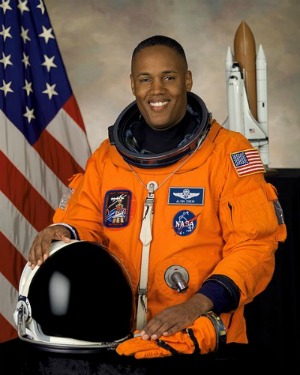
 NASA Astronaut Alvin Drew
On this, the eve’s eve of the very last space shuttle launch ever, forever, let us…celebrate? We’re kind of amazing, us humans, and as we close this chapter we’re mere moments away from embarking upon an unknown future. The next ten, twenty years stretches ahead of us inside a big, empty hangar decorated with “Thank You, Atlantis” banners. Doesn’t it excite you to wonder what we’ll fill it with?
I realized recently that my sadness at the end of the exploration program that I’ve spent my whole life watching — space shuttle Columbia launched on its maiden voyage just days before my second birthday — is largely sadness at the number of people who have still never really stopped to watch. So on this eve’s eve, mark your calendars: Friday, July 8 at 11:26 a.m. Take a morning off of work and join me at the National Air & Space Museum to watch space shuttle Atlantis leave Earth with a crew of four men and women. The museum opens at 10 a.m.; try to get there by at least 10:30 a.m. and head to the Moving Beyond Earth gallery, where a huge wall-size screen will show the launch. If you’re out in Virginia, go to the Udvar-Hazy Center and watch in the same room with Enterprise. If you really can’t get away, tune in at your desk to NASA TV. This is historic. And when you turn it off, it will be history. It’s not often we are so easily able to be a part of it.
What better way to get in the mood for a space shuttle launch than to talk to an astronaut about one? DCist sat down with Alvin Drew, a D.C. born and bred astronaut who recently flew aboard the final Discovery mission.
Drew graduated from Gonzaga College High School, going on to become a helicopter pilot for the United States Air Force, flying 60 combat missions, then moving on to be a project test pilot at the United States Naval Test Pilot School. He was selected for the astronaut corps in 2000, flying his first mission in 2007 as a mission specialist on STS-118 and second on the STS-133 Discovery flight, all-in-all logging over 600 hours in space. Astronaut Drew will be watching Friday’s launch from across the pond, where he’s assisting in the STEM program at the Scottish Space School.
Let’s start with the most important question: what is it like to launch aboard the space shuttle?
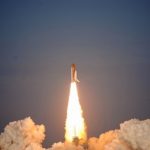
It’s a pretty exciting ride. You go from sitting at zero knots and eight and a half minutes later, you’re 100 miles up doing you know, about 17,500 miles per hour. And the power being unleashed from those engines starts to go and the solid rocket motors light. It’s pretty humbling. There’s a lot of power going off and you don’t have any illusion you’re controlling it, even though you are. And then, of course, the Gs and watching the Earth go from light blue, to midnight blue, to complete black as you get up in altitude. We describe it as an E-ticket ride.
Mission STS-133 in February/March 2011 was your second flight, but the first time you performed a spacewalk. What’s that like?
It was breathtaking to go up there the first time. It’s almost overwhelming. It’s one thing to look at a picture of space and being in space [inside the shuttle], but it just doesn’t quite capture the experience… I don’t know if you’ve ever been on a motorcycle, but the difference between being in a spaceship looking out at the world and being out there on a spacewalk is the difference between being in a car and riding a motorcycle, where you’re being completely immersed in the scene and it’s completely around you and you’ve got this tiny ‘spaceship’ that is kinda shaped like you and that’s what’s between you and the universe. And trying to keep that in mind while you’ve got six hours of tasks ahead of you so you can’t spend too much time being blown away by it all.
Can you tell us about what some of your duties were on these spacewalks?
Our spacewalks were unplanned tasks initially. We had an ammonia pump that failed — we have four different cooling systems on board the space station. Oddly enough in space the hardest thing we have to do is keep the space station from overheating. And it’s fine as long as any two of those four are working, but once you get below that you have problems, and we had one of those cooling units fail last summer, so we sent a crew, Tracy Caldwell Dyson and Doug Wheelock, out to go and replace that failed pump module.
But we wanted to get this broken one back on the last space shuttle so we can figure out what went wrong and do some troubleshooting. It’s a big beast; it’s about 800 pounds, about the size of a kitchen refrigerator…probably like two refrigerators. We had Steve [Lindsay] working the robot arm and me doing the free float tasks to get this thing put in its proper spot and tied down to bring home. Then we had lots of other tasks once we were out the door, because we [initially] weren’t going to do any spacewalks, but we had lots of tasks that didn’t really rate their own spacewalk, so once we decided on that one task there were lots of other little jobs to do. So we fixed some lights and did some repairs and upgrades while we were out there.
Can you tell us a little bit about what it’s like being aboard the International Space Station? Any favorite or least favorite parts?
When you fly the space shuttle, those of us from modern aviation, it’s a weird step into the past. It’s a very vintage spacecraft, despite the fact it’s got glass cockpit displays — the computers are old, the interfaces are old, it looks like something that comes from the era of F4s and Chinook helicopters, like something from the 1970s or ’80s. And then you go to the space station and it’s like you step into the 21st century — the interfaces of the space station are all laptops you plug into ports with a wireless internet system, so there’s no banks of switches and dials and gauges. It’s big, it’s light, it’s airy and so it’s kind of just this big, floating laboratory up there.
My favorite part up there is one of the most recent, it’s called the cupola — it is a hemisphere dome with six sides on it going around a center window in the apex that gives you this bay window view of the earth down below — it points straight down to the Earth, and it’s good for either working the robotic arm or to watch docking vehicles come aboard the space station, or just looking out the window and seeing the Earth go by. And so it’s one place you get lots of natural sunlight coming in — the space station doesn’t have very many windows, so it’s the one place you can go to get some natural light on you.
So when you were passing over D.C., what did it look like from space?
Yeah, oddly enough it’s easy to pick out cities at night because of the lights. In the daytime, especially if it’s spring or summer, cities are just kind of a gray smear against this green background, so there’s nothing that jumps out at you. In the wintertime, I’ve found that cities are easier to pick out because when they plow the streets, the black streets really stand out against the snow, so you can actually make out street patterns. But at night you can really see the lights around cities — D.C.’s really easy to pick out because you can see where the Anacostia meets the Potomac — and where that split is, you know you’re looking right down at D.C.
What are your feelings about being part of Discovery’s final mission?
I’m very proud to be part of Discovery’s final mission, and very proud to be part of the space shuttle program. You know, when I first got here, I was just happy to be an astronaut and this was the deal, the job was to go fly shuttles and that’s something we assumed we’d be doing all the time, but that just wasn’t the daily reality. When I got on the 133 mission, it was actually slated to be the very last shuttle mission, and since then we put two more behind it, but you know, I thought about the whole thing and remember thinking back to the X-15 program and how lucky someone would have been to be part of a program to fly these hypersonic vehicles and do all the great things they did. They actually flew more missions than the shuttle, they did 199 X-15 flights… and I thought about things like the Mercury program. I was always kinda jealous of those guys because they were doing things that nobody else had ever done and they were the pioneers doing it …and then I’d think about the shuttle missions and I’d think we’re actually doing some of the most complex and elaborate missions that anybody’s ever done in space.
I remember back when any mission with a spacewalk was considered to be something special and out of the ordinary, and now we do them every mission. I don’t think we’ve ever had a mission since I’ve been here that we haven’t done multiple spacewalks. And working the robotic arm operations, that was considered something special and we do those all the time now. Building this space station really pushed this agency to the top of its game. We get Apollo astronauts and Mercury astronauts coming in here and saying, “I can’t believe you guys are doing what you’re doing” and you’d say, “Well, you guys went to the moon” and they say, “That’s not as complex as what you’re doing right now.” So I gained a sense of how far we’ve come and I really was proud to be a part of that.
You spent most of 2009 as Director of Operations at the Russian Cosmonaut Training Center. How were you assigned that task, and what was it like living and working there?
It was a fascinating experience. Russia is clearly a very different culture and different country from ours. We’ve been working together since the early ’90s, so it’s probably coming up on 20 years together. We’re two countries that evolved our space programs completely separated from one another because of the rivalries of the Cold War, and so looking at how the Russian space program works and the technologies and methods they use to design and operate their rockets is — they’ve just got a very different way of skinning that cat. And so it was fascinating to look at how they’ve solved some of the same problems that we’ve solved in very different and ingenious ways.
And the other side of that is the guys who work with the Russian Space Agency, the Russian Air Force and, of course, our own U.S. embassy in Moscow — watching those agencies all work together to make our partnership in the space program work. It was pretty fascinating, and I was proud of our cooperation in space — one of the legacies of the end of the Cold War was the cooperation we had for our space programs.
I have been told that you’re descended from the famous surgeon and medical researcher, Charles Drew, and have other family members such as the former D.C. councilmember Charlene Drew Jarvis and astronaut Fred Gregory, is that right?
We were actually trying to figure out where we line up — we’ve never established for sure the common ancestry between us all, but we do know that both my family, the Drews, are the same family of Drews. Fred Gregory is actually Dr. Charles Drew’s direct nephew — we all came from the same part of Virginia, by Lynchburg — and so it’s a matter of going over and figuring out who it was. It seems like too much of a coincidence that two lines of Drews would come out of the same small town in western Virginia.
Growing up in D.C., what’s your favorite place to be in the city and what’s your favorite place to grab a bite to eat?
Oh let’s see, I’ve got a few different spots that I like to go to when I’m in D.C. There’s a place called Colonel Brooks’ Tavern up in Northeast D.C., which is near my old grade school. I like to go there every now and again, it’s got a very good neighborhood feel and it’s near where I grew up, so it’s got a bit of nostalgia for me, and good food. And there’s a few pubs out there not too far from my high school on North Capitol Street that I like to go visit because they’ve just got that old fashioned Irish pub feel to it.
Back to life in the astronaut corps – what’s it like as the shuttle era comes to a close?
It’s one of those things where we’re dealing with uncertainty, and that’s never comfortable. When I got here, I assumed that we’d be flying four shuttles a year, seven shuttles a year, and worried about those particular near-term issues. And now, we’ve got much more existential questions about life in the astronaut corps — what’s the direction, what are we gonna do? We’ve got the space station that will continue through 2020 and that gives us some sense of continuity, but what happens beyond that? Do we go back into, what I’d call “exploration mode,” and leave low-Earth orbit, or do we continue research, which is what we’ve been doing since the shuttle launched back in the 1980s, but we haven’t done much with respect to taking human presence beyond low-Earth orbit?
And so back in 2003, the mission direction was to plan to do that, go back out to the moon and look again at a few sites we were actively looking at, go out to the asteroid belt and go on to Mars – this was the goal for this particular phase of space flight, that exploration. And, of course, we were building the Constellation rocket to do that. The Constellation plan has had problems with funding and support in recent years, and so we’ve got an administration right now that says they still support interplanetary exploration, but not with that particular rocket. So we’re looking to see, how do we go about doing that? What are the alternatives? With the shuttle going away, we are now getting rides to the space station with the Russians and we’re looking at commercial options to go to the space station — how that’s going to pan out, if they will succeed, and will they incorporate some of the hard-learned lessons that we’ve learned at NASA… sometimes we paid that tuition in blood about what should and should not work on these capsules. And so we understand they have some great innovative things they want to bring in, but we also need to make sure they don’t lose some of the lessons from the past. We’re not sure how this is all going to play out and how it’s going to work … and so there’s a tremendous amount of uncertainty in the astronaut office.
What do you think about where human space flight should go? Do you think we should just concentrate on the ISS right now and build up more low-Earth orbit commercial space flight? Or are you interested in seeing us really work on a mission to Mars?
I think, all of the above. I don’t feel that they’re mutually exclusive. Of course, you’re going to have budget constraints, which are going to affect the timing. In 1948, Werner von Braun laid out a vision for how we could go explore space, and to this day I still think it’s the definitive vision for what we should be pursuing. His main goal was that we would have a platform in space — multiple space stations orbiting, doing research and also serving as launching platforms for interplanetary travel. The ships we’d take interplanetary don’t look like ships we’d take to the moon, they’re bigger and more complex and we wouldn’t send them up through the atmosphere, we’d send them up from low-Earth orbit. We’d also have a fleet of shuttles or at least capsules to resupply and bring people to and from those orbiting space stations. And, of course, we’d have these interplanetary rockets going up and exploring the solar system. And we’ve done bits and pieces of that, but we’ve never done them all at the same time. We’ll eventually get there where we have shuttles and space stations and interplanetary rockets all at the same time. It’s just, when will that happen? And that’s where I think we’re going in the next 30 to 50 years.
Why do you believe the space program — both human spaceflight and all our unmanned operations — is important?
A couple of things, one very near-term, is that the things we’re learning in doing our current space travel — trying to make space stations and going on planetary missions — helps us directly here on Earth. One of the big things we do on the space station — we’ve got very limited resources; we have a finite amount of air, a finite amount of water and finite amounts of food and so we have to be very conservative with it. And some of those technologies go right back with things we’re trying to do on the planet right now in terms of conserving our environment and conserving our resources — so everything we’re doing up there right now seems to have a dual purpose to it.
The ultimate, very long-term goal, even a millennium in the future, is that we’re going to need to expand our human presence out beyond Earth. We’ve got all of humanity in this one basket called Earth and it has a bad habit of wiping out its dominant species every few million years, so it’s a matter of time before our lease expires. So if a super volcano or asteroid wiped out all the humans on Earth, we’d still have humans on Venus or humans on Mars or humans on the moon who could come back and pick up the pieces.