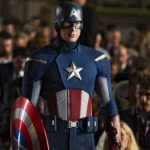
 Kids, I just want to be clear on this point: performance enhancing drugs have no place in sports. Being that all’s fair in love and war, when faced with difficulties in either of those arenas, you go ahead and do what you need to do. It was war that birthed Captain America, née 98-pound weakling Steve Rogers. Chosen by the army for an innate courage that far outpaced the abilities of his scrawny body, he participates in an experimental program designed to use chemicals and some really cool-looking and completely unexplained technology to create a super-soldier. Okay, so the rippling pecs don’t exactly hurt Rogers’ chances in the love department, either.
Taken from the pages of the Marvel comic, which was an intentionally America! Fuck Yeah!-type wartime cheerleading story first introduced in 1941, Captain America: The First Avenger manages to stick to the character’s WWII origins while still placing Rogers within the same universe that will allow him to be a part of next year’s big Avengers extravaganza alongside Iron Man, The Hulk and Thor. Perhaps most impressively, though, director Joe Johnston manages to do so with a film that, while never straying too far from comic book movie formula, still manages to be satisfying as both origin story and standalone adventure.
It’s pretty clear from where Johnston is taking his cues. Faced with telling the story of a larger than life figure facing the Nazi scourge, with a villain who is working somewhat out of the Führer’s direct reach, the director isn’t shy about Indiana Jones shoutouts, such as. Captain America doesn’t reach anywhere near those heights of action-adventure popcorn genius, but it also doesn’t suffer for the obvious comparisons.
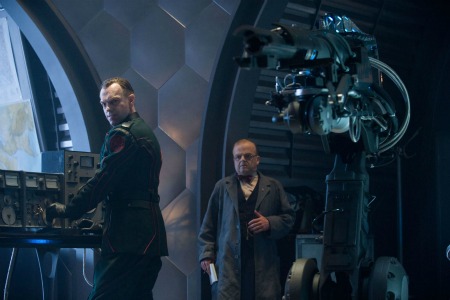 That villain is the Red Skull, played with a barely restrained glee for the fun cartoonish evil of the character by Hugo Weaving. The actor, taking the intensity of his Agent Smith villain from The Matrix and amping up the camp just slightly, and taking his accent from Werner Herzog (emphazing those sibliant S’s until he nearly sounds snakelike), proves one of the most fun big bads in any Marvel movie to date — particularly since he has a meek sidekick to play off of, Pinky and the Brain-style, in Toby Jones.
As the good Captain, Chris Evans gives the character just the kind of square-jawed earnestness it calls for, while never allowing him to be so gallant as to seem impenetrable. In the early scenes, his body is digitally shrunk in a way that’s actually much more effective, and never anywhere near as creepy, as Brad Pitt’s somewhat similar transformation in Benjamin Button. After the treatment, his muscles inflated to proportions that fill out a tight t-shirt more than adequately, Johnston does well to dispense with the usual montage of Rogers discovering his new powers, and instead puts him straight to action in a thrilling chase sequence.
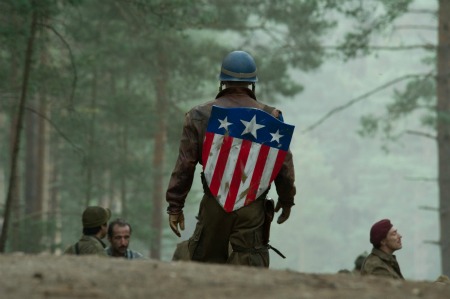
Where the movie does depart from comic expectations slightly is that it often feels more like a colorful war movie than a superhero flick. The practicality of the body armor that becomes Rogers costume — based on a more comic-booky outfit that he wears when the government decides to use him in a traveling musical propaganda show, in one of the movie’s smartest and most fun sequences — illustrates that, like the Batman movies, Marvel is thinking about how this character would exist in a real war situation. Having Tommy Lee Jones as the gruff commanding office, channeling (and even quoting) Patton, brings home the wartime setting.
So does the movie’s great escape sequence, when the Captain heads behind enemy lines to free a group of P.O.W.s. It’s an expert blend of superhero action and old-time war movie adventure, and it also gains the Captain his own international special ops team. It’s true that this coalition of the kick-ass doesn’t really have the character definition of The Dirty Dozen. They tend to follow the same easy visualized stereotypes that would help differentiate them on the page: the French one wears a beret, the Irish one wears a fisherman’s sweater and a handlebar moustache, and looks ready to do some bare-knuckle boxing in a Dublin alley. But in this context, it works.
Johnston even manages to recall the opening scene of Powell and Pressburger’s classic wartime drama A Matter of Life and Death, with the Captain having a tear-jerking conversation with a lovely female officer over the radio while piloting a plane that appears to be doomed.
This all leads up to an ending that’s unique among Marvel’s Avengers films for its subdued tone. If the Samuel Jackson post-script (which is before the credits instead of after, as they normally are) didn’t offer up the needed tie to next year’s Avengers all-star jam, it might even be a courageous way to go. Regardless, while the movie is never extraodinary, it hits all the notes you want out of this kind of movie. And leaves you humming a jaunty patriotic tune as you leave the theater, to boot.
—
Captain America: The First Avenger
Directed by Joe Johnston
Written by Christopher Markus and Stephen McFeely, based on the comic books created by Joe Simon and Jack Kirby
Starring Chris Evans, Hugo Weaving, Hayley Atwell, Tommy Lee Jones
Running time: 125 minutes
Rated PG-13 for intense sequences of sci-fi violence and action.
Opens today at theaters across the area.