Martin Austermuhle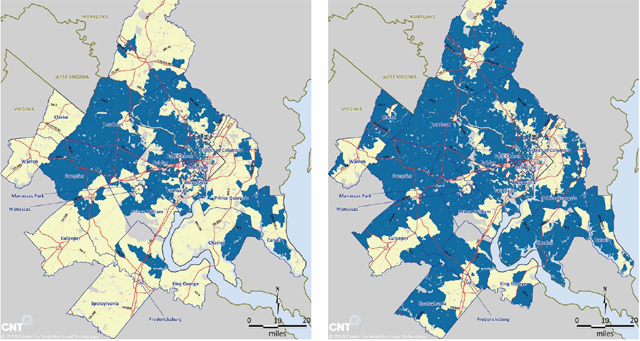
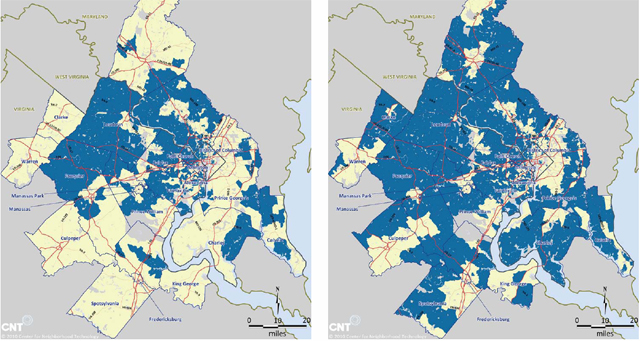 On the left, the areas in yellow indicate affordable housing. On the right, transportation costs are figured into the equation, shrinking the pool of affordable housing.
If you want to live in the District, you’ll almost certainly pay more for whatever you end up buying or renting. But if you want to live in the suburbs, those savings on housing are certain to be eaten up by significantly higher transportation costs.
That’s the not-so-surprising conclusion in a new report published today by the Center for Neighborhood Technology and D.C. Office of Planning, which states that when transportation costs are figured into the equation, affordable housing in the region becomes far more scarce. According to the report, transportation costs — which generally increase the further from urban centers you go — range from $8,500 to as much as $25,000 per year, while residents in some dense urban areas in the District pay less than that.
So what does it cost to get to and from work and play in different parts of the region? The report (PDF here, or read below) finds that the regional average stands at $1,246 per month, but significant variations can be seen depending on where you live. Along the Red Line/I-270 corridor in Montgomery County, monthly expenses hit $1,177, while in more densely populated Arlington County they stand at $975. Variations are even evident within the District — Tenleytown residents spend $1,003 a month on transportation, while their counterparts in Columbia Heights only shell out $840.
The numbers bear out what many people know from experience — higher residential density and more transit options make it cheaper for people to get around. Sure, you might be paying more for less space in that new house or condo, but alternatives further asunder may well spike your costs for getting to and from work. Summarizes the report:
The areas in the northwest of the District and extending northwest into Montgomery and Fairfax counties where housing costs are high also have some of the highest H+T costs in the region. Here, housing costs are so high that they likely overwhelm any savings these households may experience from being in location-efficient areas with low transportation costs. However, in areas in the District of Columbia, Arlington County and Alexandria, low transportation costs help keep overall H+T costs low. The outlying counties that present some of the lowest housing costs in the region look much different when considered through the lens of combined H+T costs. High average transportation costs in these areas erode the perceived savings on housing, and these areas become some of the more expensive places to live in the region.
The report also advocates for more strategic planning of development and encourages people to more broadly consider transportation costs when looking for housing. Of course, none of this is as easily done as it is said. There’s simply not much affordable housing in the District, and even a pilot program from the Office of Planning called “Live Near Your Work” that offers matching grants encouraging people to live near their offices is woefully underfunded.
Still, that the report is broadening the definition of what’s affordable when it comes to housing is good, not to mention a long overdue development. Far too many communities, both inside and out of the District, loudly complain whenever new transit options and alternatives come their way, and our default views of transportation still seem to revolve around how easily it is to drive from point A to point B.