Martin Austermuhle
 Photo by ljstantondc.
After yesterday’s earthquake, an acquaintance of mine quipped on Facebook, “If ever there’s an emergency evacuation of Washington DC, everyone will die except those riding bikes.”
Looking at the traffic that clogged area roads and the slow-going Metro soon after businesses and the government started sending their workers home, there’s certainly some truth to that. In fact, for just about every major weather or security incident or emergency in recent memory, pretty much the only people that got home normally and somewhat quickly are those that rode bikes or walked.
Generally, bicycles have been seen more as a choice — a politically divisive one at that — than as a necessity in dealing with unpredictable urban living. But yesterday again proved that in times of trouble, jumping on two wheels may well be the best alternative that exists.
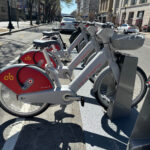
Capital Bikeshare, for example, tweeted this morning that it recorded 5,847 rides yesterday, an increase of 1,090 from the day before. Of those rides, 1,246 came between 2 and 4 p.m., compared to the 812 during that same timeframe on Monday. If you think about it, Capital Bikeshare’s 1,121 bikes distributed at the 116 stations throughout the District and Arlington are now an integral part of any plan for mobility or evacuation in case of an emergency in the city.
Terry Bellamy, the director of the District’s Department of Transportation, admitted to the Washington Business Journal’s Mike Neibauer that, despite a lesser traffic nightmare than during winter snowstorms, the region just can’t handle the massive traffic exodus that invariably follows an emergency. If you’re in a car, you’re probably screwed. On a bike, well, you might just well be lucky.
Of course, a bike isn’t the save-all every time. I’ve ridden through most types of weather, but a good solid ice storm is just as dangerous on a bike as it is frustrating in a slow-moving car. (Bikeshare has closed during particularly iffy weather, anyhow.) And should there ever be a chemical or biological attack, well, open-air cycling won’t be a particularly wise transit option. Additionally, while Capital Bikeshare is a great option in many emergency situations, bikes are single-person transit devices — and as WashCycle pointed out yesterday, many downtown stations were quickly emptied out.
Regardless, situations like yesterday’s earthquake show that while cycling can seem like a hobby or luxury to many, it can also be used as an important part of an integrated — and yes, multi-modal — evacuation or emergency response plan.
Plus, once the killer bears strike, I’m planning on out-riding those bastards.