Martin Austermuhle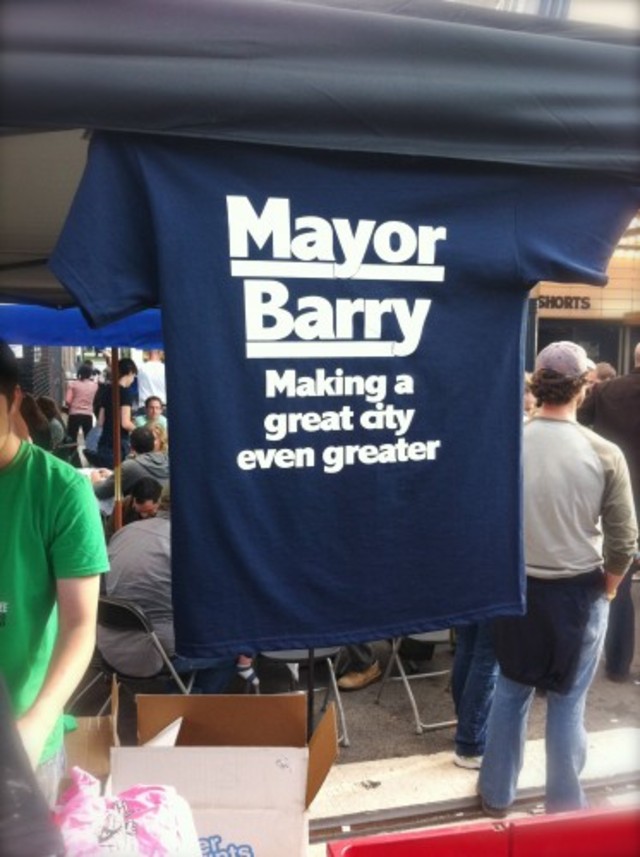
Nightlife impresario Joe Englert may already own a good chunk of the bars on H Street NE, but he’s still working to brand an area that has about as many identities as it does places to get a beer.
At Saturday’s H Street Festival, he took his first crack, rolling out a series of t-shirts that play upon, celebrate and mock some of the very stereotypes that have made the commercial corridor both the object of fawn and scorn. There’s the shirt begging for H Street to be kept “safe for beardos,” or the one shirt alternatively pleading, “Keep H Street’s Soul, Fool!” There’s a shirt pushing for a streetcar, and the shirt that Englert said inspired both ironic mockery and warm memories, depending on who eyed it — “Mayor Barry: Making a great city even greater.” (A Barry campaign poster with the same slogan can be found in Englert’s nearby Capitol Lounge.)
Englert, who made the shirts with The Argonaut’s Scott Magnuson and only started selling them to staff at H Street bars the day before the festival, says his goal is to develop a brand as successful as Austin’s “Keep Austin Weird.”
A number of other artists and graphic designers at the festival had similar ideas, producing D.C.-centric T-shirts that called upon a burgeoning pride in local neighborhoods and distinguished the city locals know and the destination tourists visit.
Joel Church and Marie Francis used the festival to introduce their line of shirts, stickers and coasters, Monumental Threads.
“D.C. is really growing,” said Francis, who, like Church, keeps a day job for now. “Neighborhood identity is very strong.”
Two of their shirts were specific to H Street NE, where they live, while another featured a number of city neighborhoods aligned around the a map of the District. Robb Stout, a graphic designer, included two H Street-specific shirts in his Highway to Hill collection, while Joe Maluso’s Brand of the Free more broadly incorporated famous Washington images that he said were popular sellers in West Coast boutiques.
Being proud of the District doesn’t mean that any of the shirt-makers were any less realistic about the local real estate market, though — all sold online or at festivals, with few hopes of opening actual stores.