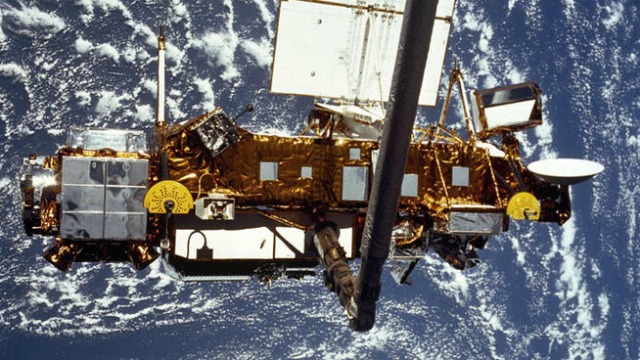
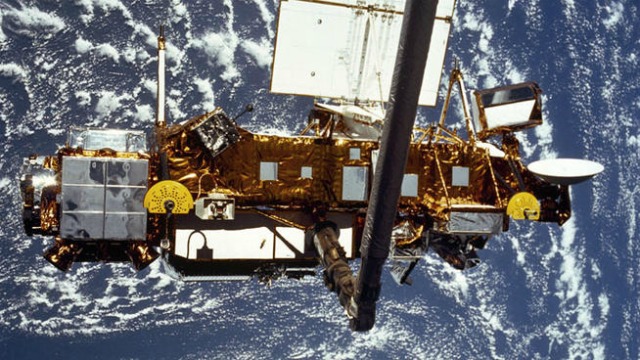
 Photo courtesy NASA.
We love space, astronauts and science around these parts. But we wouldn’t really be very honest if we weren’t slightly unnerved at the fact that when a defunct six-ton satellite is going to come crashing to Earth, NASA isn’t exactly sure where it is going to land.
Oh, they’ve got a general idea, though:
The Upper Atmosphere Research Satellite, launched in 1993 to study climate conditions, weighs approximately 6 tons – about the same as a city bus.
Researchers say there is a 1-in-3,200 chance that the satellite will land on a person during its fiery descent through the atmosphere.
NASA cannot project exactly where that satellite is going to fall. The best estimate places the crash zone somewhere between the latitudes 57 degrees north and 57 degrees south – an area that encompasses most of the inhabited world.
That means you, anyone who lives in a section of land located anywhere between Canada, Russia and Scandiavia and the southern tips of South America, Africa and Australia! Residents of Greenland, however, can breathe easy.