Martin Austermuhle
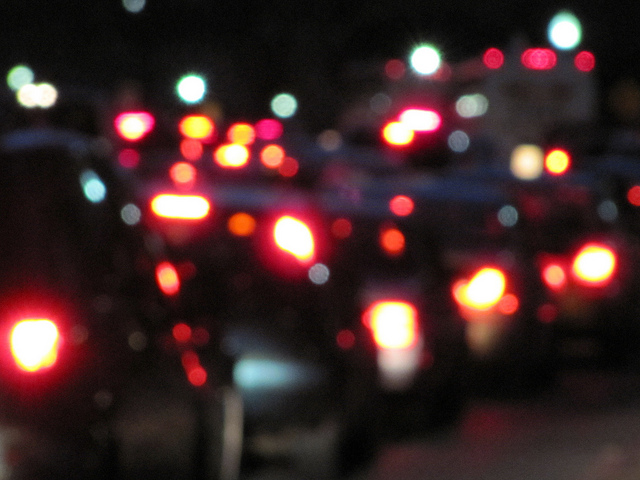 Photo by Katieforeman2010.
Seventy-four hours. Thirty-seven gallons of gas. Almost $1,500 a year.
That’s the individual cost of congestion in the Washington, D.C. metro area according to the 2011 Urban Mobility Study published by the Texas Transportation Institute, putting us atop all of our urban competitors in terms of the severity of the traffic we deal with on a daily basis. So severe is our traffic, in fact, that we’re currently worse off than Chicago, Los Angeles, Houston and New York.
All told, congestion across the country got so bad in 2010 that Americans were forced to travel 4.8 billion extra hours and waste an additional 1.9 billion gallons of fuel, costing the country a collective $101 billion. (Thankfully, that was time spent listening to great daytime talk radio, right? Oh, wait.) The future isn’t looking much brighter, either. According to the report, national congestion will waste 7.7 billion hours and 3.2 billion gallons of gas and cost $175 billion in 2020.
The report offers a number of solutions, ranging from increased capacity in both roads and alternatives like public transit, changes in usage patterns and new development patterns so that people have to travel less to get what they need.
Of course, as we’ve argued before, more roads probably won’t be the answer, at least not locally. According to the report, the District one of 42 urban areas in which demand for roads outstripped supply by over 30 percent, meaning that we’d need a lot of roads right now just to meet the amount of cars currently trying to use them. (Speaking of additional road capacity, last week Virginia Sen. Mark Warner advocated building new bridges across the Potomac.)
The report quantifies how much public transportation saves the country’s 15 largest urban areas, including the D.C. metro region. In 2010, passengers traveled 41 million miles on public transit, saving themselves and their neighbors 681 million hours, 271 million gallons of gas and $14 billion in productive time.