Martin Austermuhle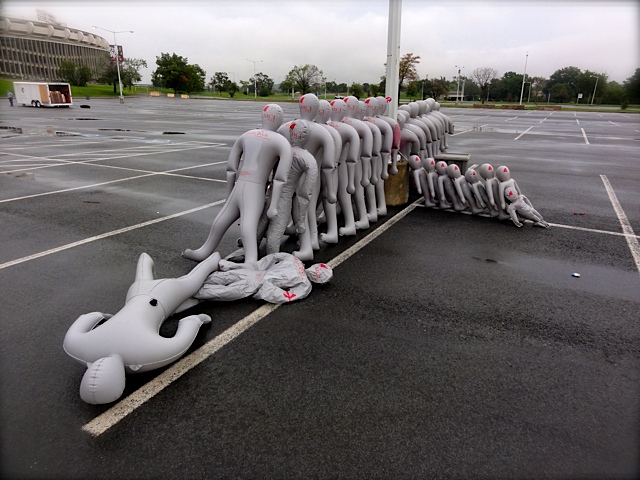
In recent years, the District has been hit by record snowfalls, torrential rains, a hurricane and an earthquake. Fortunately, none of them have been particularly catastrophic — but that doesn’t mean that District officials aren’t constantly preparing for one that could be.
Today at RFK Stadium, the D.C. Homeland Security and Emergency Management Agency led a disaster simulation, drawing in volunteers and over 200 city workers from a number of agencies to test how the District would respond under the worst of circumstances. In this case, a Category 2 hurricane had hit the city, leaving almost 90,000 homes without power and low-lying areas flooded.
Inside the stadium, volunteers assigned to play different characters entered a mega-shelter that could serve and house up to 2,000 people in the event of an emergency. Each character acted out their story, while volunteers and officials from the Red Cross and city agencies assessed them and responded accordingly. One character, 18-year-old Steven Nadeau, was looking for his parents, so while he used a computer to send them Facebook messages, officials checked local shelters. Another, a veteran who had served in Afghanistan and suffered from PTSD and alcoholism, was attended to by a worker from the Department of Mental Health. Once a volunteer had worked their way through the various stations, they could choose to be assigned another story to act out — there were 100 in all.
Outside, city agencies respond to different scenarios as they would in an emergency. Two overturned cars were righted and towed by the Department of Public Works, while a city worker used a wheel loader to clear garbage bags that were supposed to represent a collapsed building in Adams Morgan. (One of the simulation’s organizer’s said it was Madam’s Organ, the bar.) Nearby, workers from the Office of the Chief Medical Examiner, working under the assumption that their Southeast headquarters had flooded, set up a portable morgue that could handle 48 bodies and cool them within 24 hours.
Fire/EMS and the Metropolitan Police Department both had mobile command units set up, with police using theirs as a substitute to a headquarters that was said to be without power. From the command unit, police could access department computers, communicate with officers and map out their response as it happened. And for the first time, a team was present to set up a pet shelter that could hold 200 to 300 dogs (or more cats) and quarantine any that may be a threat.
The simulation was run by CNA, a consulting firm that has long contracted with the District and worked with the city on preparations for President Barack Obama’s 2008 inauguration. According to Nicole Nadal, an associate research analyst with the firm, the disaster had been chosen six months ago, and the goal was to force city agencies to respond to something that’s “not crazy, but realistic, so that there’s buy-in.” After the simulation, the firm would provide the District with an after-action report and corrective action plan based on what they observed.
Millicent W. West, HSEMA’s director, said that the point of the simulation was to “patch the gaps” and work with city officials that may not otherwise have to deal with disaster.
“What we want to do is not focus on people that do this every day, the public safety folks, but folks who are dealing with residents every day for other human service needs,” she said.
West noted that exercises and simulations of this type took place on a regular basis — the last one was in May, the next is in March — and tested city agencies under different scenarios, both natural and man-made.
Of course, as recent incidents have proven, even best-laid plans can fall victim to reality. The August earthquake showed that once everyone wants to get out of town, there’s not much anyone can do to speed up or smooth the process. West said that she would continue working with federal officials and neighboring states to better coordinate communication.
Ironically enough, the simulation was supposed to have taken a few weeks ago — but the earthquake and Hurricane Irene forced it to be re-scheduled.