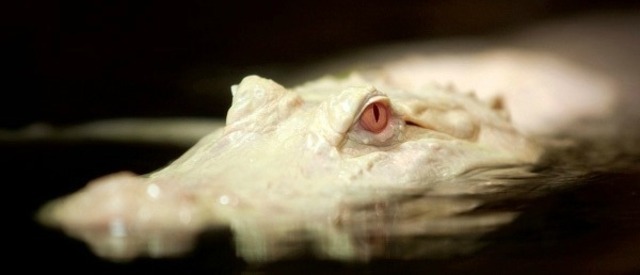
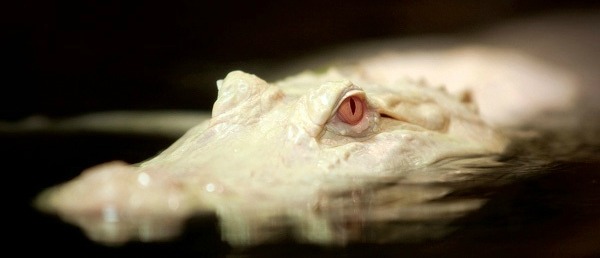
 Secrets of the Swamp, Albino American Alligator, National Aquarium, Washington, D.C.
>> On October 7, the National Aquarium unveils the Secrets of the Swamp with a very special visitor, just in time for Halloween. This rare, red-eyed ghostly albino alligator will rival Croctopus and Mega Shark as the creepiest creature to cast a shadow underfoot next time you’re out for a swim. (“Did you feel that?”) Originally from St. Augustine Alligator Farm, Albinogator will haunt your dreams his very own tank equipped with special low-UV lighting to protect his skin. He sunburns easily and bright lights hurt his eyes and, since he can’t blend into his natural surroundings, hunting for food is much harder, making survival rates pretty dim — he’s one of only 100 albino gators in the world. Stop by the National Aquarium on Fridays at 2 p.m. and hear terrifying stories interesting facts about these incredible beasts, like how their teeth replace each other when they fall out and how they can hold their breath underwater for an hour. Albinogator will be in town through February 2012. General admission tickets cost $9.95.
>> Not only is their milk used to make cheese, cows cut the cheese more than most other animals on the planet. Leucochloridium worms create zombie snail armies with pulsating eye stalks that are irresistible to birds, an integral part of the zombie worm’s reproductive cycle. Carnivore poo is long and thin with pointed ends, while herbivores poop out small, round piles. Owls barf up all the indigestible stuff like bones and fur within 24 hours after eating, so their little puke balls are perfect for constructing a chipmunk skeleton, if you’re so inclined. Learn fascinating facts like these, and more, at National Geographic’s new Animal Grossology exhibit. While you’re there, learn some Weird But True facts about our natural world in the companion exhibit. Museum admission is $8 for adults and $4-6 for students and children.
>> The National Air and Space Museum has a full calendar this month. The Ask An Expert series continues on October 5 from 12 to 12:15 p.m. with Lunar Rocks: What They Can Tell Us About the History of the Earth and Moon, led by planetary scientist Gareth Morgan who will discuss the missions that collected the Apollo lunar soil samples. Morgan returns on October 8 to talk about The Changing Face of the Moon: Exploring the Ancient History of Giant Impacts and Volcanism, part of the Smithsonian’s Stars Lecture Series. Head out to the Steven F. Udvar-Hazy Center on October 29 for the 7th annual Air & Scare! for trick-or-treating and other spooky activities. Don’t forget to wear a costume! 2 to 8 p.m., Free, but parking is $15. Look through the Museum’s October calendar for even more activities throughout the month.
>> The National Museum of American History hosts a series of book signings for A Pilot’s Journey, in which author George Norfleet tells the story of World War II’s Tuskegee Airmen on October 6, 13, 20 and 27 from 12 to 5 p.m. On October 6 and 13, join a Smithsonian horticulturist for a tour and discussion of some of the plants in the museum’s Victory garden, weather permitting. Tours will meet at the Welcome Desk located at the Constitution Avenue Entrance on the First Floor. For a complete list of events happening at the Museum this month, take a look at the handy calendar online. It’s also your last chance to catch Have You Heard the One…? The Phyllis Diller Gag File, which closes October 28.
>> The National Museum of Women in the Arts opens two new exhibits at the end of the month. Visions of the Orient: Western Women Artists in Asia 1900-1940 explores the Japanese woodblock print movement of Western artists with 125 prints and paintings. TROVE: The Collection in Depth focuses on five categories of work — plants and animals, landscape, portraiture, family relationships, and memory — to provide a complete overview of the contribution and perspective of women artists with more than 100 works from the Museum’s permanent collection. Both exhibits open on October 28. $10 admission.
>> Travel back in time to a less desensitized world, before the instant updates made possible by satellites and the Internet, when newspapers were the main artery delivering news from the Civil War’s front lines. The Newseum presents Blood & Ink: Front Pages from the Civil War, featuring a display of more than 30 historic front pages from Northern and Southern newspapers showing both Union and Confederate viewpoints, including a front page used by a Union soldier to write a note to his mother. Entry to the exhibit is included with general admission tickets, which are valid for entry on two consecutive days.
>> Appointed as head of the Navy by President George Washington after the Revolutionary War, John Barry helped open trade with China and one of the founding fathers of the United States Navy. Learn more about John Barry: An American Hero in the Age of Sail at a presentation, Q&A session and book signing with author Tim McGrath on October 13 at 12 p.m. at the United States Navy Memorial, followed by an official Navy Birthday wreath laying ceremony at 1 p.m. on the plaza, all in celebration of the United States Navy’s 236th Birthday.
>> On October 5, the Smithsonian American Art Museum hosts Encuentros: Artistic Exchange between the U.S. and Latin America, a two-day symposium on the artistic exchange between Latin America and the United States beginning in the late nineteenth century. This event is free and open to the public, but registration is required.
>> Join the Textile Museum on October 8 for Otsukimi: Moon Viewing at The TM an evening celebrating the ancient Japanese custom of admiring the “harvest moon” in the Museum’s own garden, complete with a traditional tea ceremony, 6:30 to 9 p.m. Tickets required.
>> The Phillips Collection has two exhibits opening this month. On October 1, Degas’s Dancers at the Barre: Point and Counterpoint provides a retrospective of Edgar Degas’ fascination with ballet and features over 30 pieces marking its prevalence in his work from 1870s to 1900, including his most iconic image. Then, on October 22, Eye to Eye: Joseph Marioni at the Phillips opens with 45 works from the modernist painter whose highly-saturated, heavily-layered canvases explore color and light in a multi-dimensional, monochromatic illusion. The exhibit includes 15 recent works alongside 30 paintings from the Phillips’ permanent collection selected by the artist, himself.