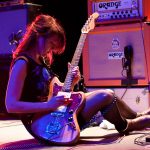
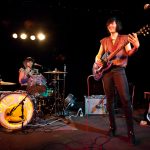
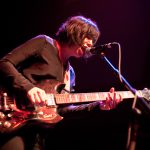
Mary Timony (third from left) and Wild Flag. In a city known for transience, Wild Flag’s Mary Timony is a rara avis: a D.C. native who still calls the city home. Rarer still, Timony’s an accomplished musician who has been performing continuously for 20 years, while staying true to the punk influence she experienced growing up in D.C. during the early years of Dischord Records. As a founding member of the all-girl post-punk band Autoclave, Timony is getting back to her roots: she and the three other members of Wild Flag are delighting fans of their collective former projects (Sleater-Kinney, Helium, The Spells, The Minders and Quasi) as well as winning over new ears with their infectious post-punk harmonies.
Tell me a little bit about how Wild Flag came to be. You had all worked together before in different capacities, but then you came together to write the score for !Women Art Revolution. When did you know something greater was at play, that you’d be writing a debut album, and hitting the road?
I live in D.C., obviously, and those guys are in Portland. I just got a call from Carrie [Brownstein] and she told me they were going to get together to write the songs for !Women Art Revolution, and she invited me to come out and write with them. They got together in Portland and wrote the instrumental music. The director, Lynn Hershman, asked them to put vocals to it, and Carrie called me up and asked if I wanted to give it a try. I didn’t actually go to Portland; I recorded them here. It’s so easy when you’re sharing files, doing music digitally.
Did you expect the reaction you’ve received?
Personally, I wasn’t even thinking about what the reaction would be. It was nice. People reacted generally pretty well.
You were in Autoclave, here in D.C. 20 years ago. How does the experience of being in an all-girl rock band then compare to now? Are there a different set of challenges, or rewards?
I can’t tell you if it was because it was the early ’90s, or if it was because I was only 19, but it was more of a novelty then, than it is now. It felt like much more of a statement. And I think it’s a combination of just the fact that we were so young, and it could have just been that we were asserting ourselves anyway, not just that we were women. Being in a band was a new experience for me. I think it was just a little bit more of a statement then. Now, it doesn’t really feel like an issue because we’re adults, and it’s not such a new world for us. And I think that there are slightly more women in rock music.
You attended Duke Ellington School of the Arts here in D.C. and studied music. What did you study, and how did your time there shape your career as a musician?
I went there for guitar. I with studied Tom Newman. It was awesome. It was such a great experience. I got so much out of it. They’d do academic classes in the morning, and then the afternoon you spend studying. I just spent an hour or two or three playing guitar every day in school, and then I would practice for hours when I got home. I was practicing guitar a lot at that age. The program was great. It was amazing to be around so many musicians and have such great teachers. It’s so inspiring; one of the best experiences I’ve had in my life. I love that school.
When you were in high school, and then starting Autoclave, what was the best part of the music scene in D.C. at that time?
It was a really exciting time in the music scene in D.C. There were a lot of bands, and a lot of shows, and a lot of people involved. The hardcore punk scene in D.C. was really active. There were some really great bands. I’d go out and see shows every weekend. I don’t know what my favorite part about it was, but it was a really exciting time. I loved seeing Fugazi; I’ve seen them many, many times.
What were the venues at that time that would compare to Black Cat, Rock and Roll Hotel and others?
d.c. space, and 9:30 Club was down on F Street. d.c. space is now actually Starbucks on 7th Street. It’s so crazy how so much of that neighborhood is built up. d.c. space was about the size of the downstairs of Black Cat. Do you know where Jaleo is? Right across from there. It was probably the main club that had shows at that time, besides 9:30. Most of the shows were in the Wilson Center, which is not there anymore, but the building is. It’s a church now in Columbia Heights. The first show I ever went to was at the Chevy Chase Community Center; The Faith, and maybe Rites of Spring. It’s still there. I go to yoga there with my mom now.
What are your plans right now for Soft Power?
We have been working on a record. It’s a little bit on hold right now because I’ve been really, really busy, but we recorded a bunch of songs and need to finish them up.
You call D.C. home. What’s the best part of living in D.C.?
My family is there. My parents are there. My brother’s there. It’s a beautiful city. I love my friends. Good, right?
All good reasons. If you could curate a show with all D.C.-based bands, who would you choose? Where would you play?
The ones I’m thinking of would be The Aquarium, Jason Hudo and Laura Harris. Then I would choose Garland of Hours, which is my friend Amy Domingues’s band. I play in it sometimes. Am I allowed to choose that one? Felt Letters, which is Ian Svenonious’s band. Brendan Canty’s solo project. Benjy Ferreee. He put out two really amazing records. It’d be a really big show.
That’s fine. It can be an all-day festival. Where would you play?
Does this have to be in reality? Could this be anywhere?
It doesn’t have to be a real venue. You could take over the Starbucks that was d.c. space.
Probably Pavillion Arts Gallery. Down on 7th Street across from the Convention Center.
Wild Flag headlines the Black Cat mainstage tonight. Eleanor Friedberger (of The Fiery Furnaces) opens. Doors are at 8 p.m. The show is sold out.