Martin Austermuhle
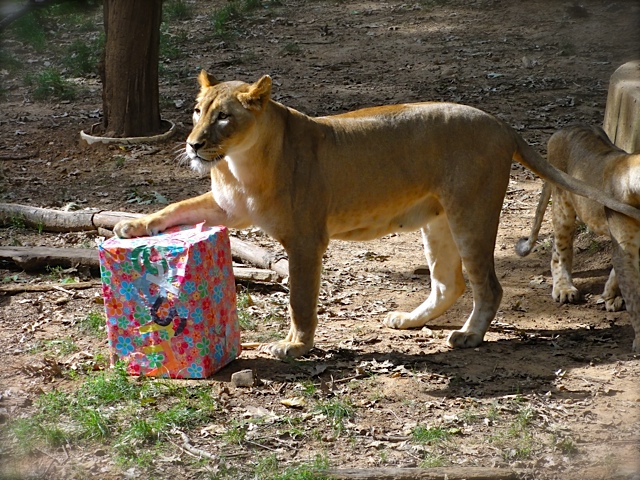 The National Zoo’s lions might be awesome, but they can’t be your pet in the District.
Last week, an Ohio man who owned an exotic animal preserve freed 56 wild animals, including lions, tigers and wolves, before killing himself. Citing the imminent danger to the community, police shot and killed 49 of the animals.
The incident got us to thinking — what exactly are the rules in the District when it comes to owning non-standard pets? Would a resident be able to keep a lion, tiger, coyote or flamingo in their backyard?
The simple answer is no, according to D.C. law:
[N]o person shall import into the District, possess, display, offer for sale, trade, barter, exchange, or adoption, or give as a household pet any living member of the animal kingdom including those born or raised in captivity, except the following: domestic dogs (excluding hybrids with wolves, coyotes, or jackals), domestic cats (excluding hybrids with ocelots or margays), domesticated rodents and rabbits, captive-bred species of common cage birds, nonpoisonous snakes, fish, and turtles, traditionally kept in the home for pleasure rather than for commercial purposes, and racing pigeons (when kept in compliance with permit requirements).
There are a few exceptions, of course. Zoos, permitted circuses and federally licensed animal exhibitors, for one. Wildlife rehabilitators and vets can also have exotic animals on hand, but only “for treatment or pending appropriate disposition.” Finally, the law grandfathers in anyone who owned “domestic dog hybrids of wolves, coyotes, or jackals” prior to March 17, 1993.
Obviously, that these laws are on the books doesn’t mean that exotic animals haven’t been found in the District in the past. According to Scott Giacoppo, vice president of the Washington Humane Society, everything from alligators to poisonous snakes to primates have been found within city limits.
“You never know what you’re gonna find,” he said. Giacoppo additionally noted that the Humane Society is often the first line of defense to ensure that the animals are safely captured and placed with a rescue group somewhere in the country.
Other things you should know? Once an animals becomes your pet, it’s illegal to just let it go. And if you happen to own a baby chicken, duckling or rabbit, changing its natural color is a big no-no — as is selling one whose color has been changed.
No matter how much you insist that pigs really are clean, note this: “Keeping, herding, and feeding of hogs, in pens or otherwise, within the District shall be considered a nuisance injurious to health.” Cows, horses and mules are okay, but only if kept in a stable, and only if the city’s Department of Health is notified.
If you’re planning on owning or keeping seven mammals larger than a guinea pig and over the age of four months, you have to get yourself an animal hobby permit. And if you’re a teacher looking to have a classroom animal, District law states that “only animals of appropriate size and temperament suitable to a classroom environment” can be brought in — and only for instructional purposes.
The District’s laws seem reasonable enough for an urban area, and downright sane when compared to Virginia’s. The Post reports today that the Old Dominion requires permits for big cats, bears and wolves, but not for primates.